Home Blog Page 199

Microsoft And Samsung Lay The Groundwork For Future Double-Folding, Triple-Screen Smartphone

Triple-Screen Smartphone

Microsoft and Samsung illustrate how their next generations of foldable smartphones could come with a triple folding screen system.

The patents registered by both companies demonstrate the possibility of such implementation — focus on the incorporation of a double hinge so that the three segments of the panel can be adapted to different uses as needed.

In the case of Microsoft, Windows Central explains that its patent was publicly known last week but whose registration dates from June 2020. In it you can see an illustration of what the hypothetical smartphone would look like with its triple folding screen. The aforementioned report mentions that the idea of ​​the Redmond signature is not illogical and would solve some of the great problems that the two generations of the Surface Duo have presented so far.

Microsoft Triple-Screen Smartphone

The use of a double hinge would serve not only to extend the interaction surface when the three panels are aligned; it would also allow one to always be exposed when they are closed. This would also explain why the hinges would be unidirectional and not bidirectional, as in current models.

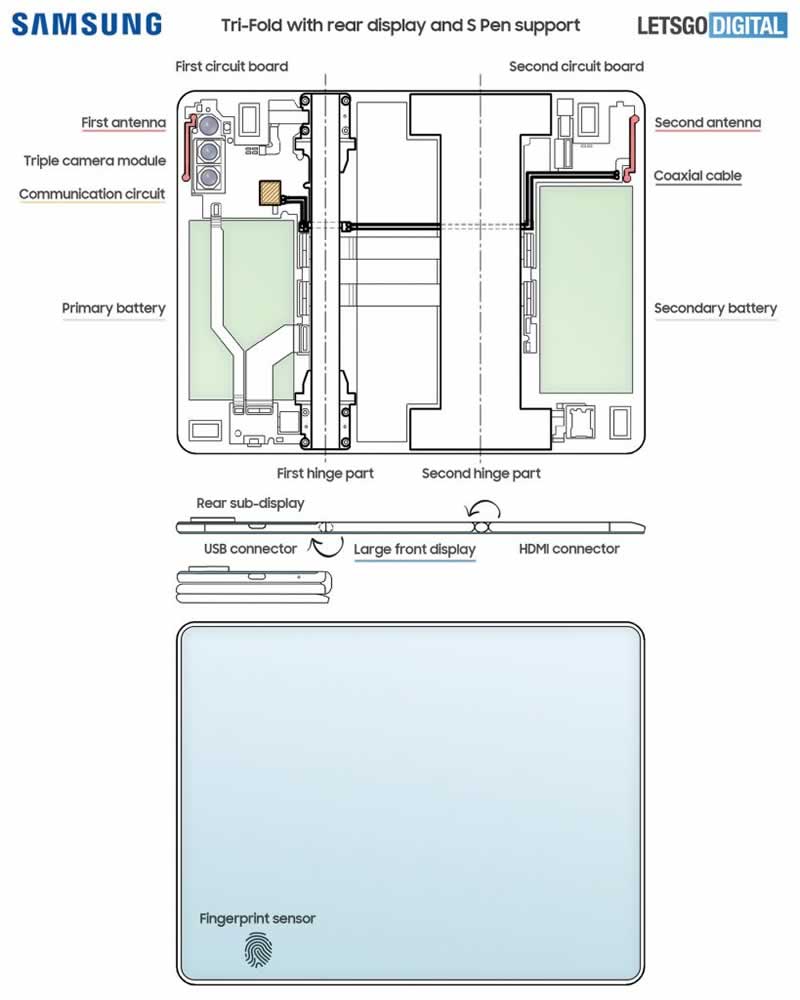
Similar to Microsoft, Samsung also patented a design with a double hinge and three folding screen sections, as LetsGoDigital reports the unofficially baptized “Galaxy Tri-Fold”.

Samsung Triple-Screen Smartphone

The documentation of Samsung’s double-folding, triple-screen smartphone mentioned that it could come with both the fingerprint reader and the front camera under the screen; and also with a triple rear camera, HDMI connector and support for S-Pen.

Even though these companies are able to bring this form factor to the market, there are still several problems to solve. The first – and the most obvious – has to do with the dimensions of the device. The double hinge and the Z-type fold would make the mobiles considerably thicker and heavier than those that exist today. Therefore, the challenge will be to make these folding mobiles visually appealing and versatile enough to please the public.

The Role of Virtual Data Rooms in Business Development

Virtual Data Room Providers

A profitable company is always looking for ways to improve. Testing out new products, searching for new areas they can influence, and maybe even finding a similar business to collaborate with — those are all characteristics of a great, constantly developing company. However, during their efforts, they might need additional tools that will enable them a better understanding of what is happening inside of the company as well as allow partnerships to flourish.

A solution like that is already available on the market, and many businesses that are keen on their constant development are already subscribing to it. This solution is called a virtual data room, and it has a quite significant impact on the developmental process of a company. 

1. Gathering investors

When a company is just starting out, it needs to find funding for its ideas. Startups are in need of good data room providers thanks to whom they can showcase their ideas, and invite others to give comments and suggestions on what parts of the project to improve. They can gauge the interest of potential investors thanks to the reports feature. This gives the startup data about how long someone has spent on a document, and what kinds of activities they did inside of the online file repository. 

According to that information, the company prepares itself for a meeting with them and pitches their ideas in a much more refined way. And if they agree to back it, they can continue using the data room solution as a place for updates. 

2. Updating everyone on the progress

An electronic data room can also be used as a place for updates in the development of a new product. This way the investor will know where their money went, and how it is managed. This will also enable the company to keep track of new breakthroughs, vet the process even more, and see what kinds of additional steps need to be taken in order for the company to finish that particular product.

It all creates a lot of additional paperwork, but thanks to the management tools hidden in the toolbox of virtual data room providers, the company is able to keep up with the influx of documentation.

3. Managing company documents 

All of the files need to go somewhere. Virtual data rooms are spaces that were designed for secure file storage, so it is hard to imagine a place less secure than this online file repository. Adding onto that a layer of useful management tools, like adding tags to files, or putting them in a template structure can all help in the company’s workflow. However, as the company develops, it might also be considering working with other companies. Data room software can also help with that. 

4. Collaborating with other businesses 

Just as the company would use a virtual data room for their startup needs, they can continue using it when it comes to collaborating with other companies. Both sides of the deal need to share a fair deal of confidential data when it comes to collaborating on any kind of project. 

This being said, this online data room software can be utilized for brainstorming ideas, asking questions and refining the product even more. And after such a collaborative effort is completed, you can invite other parties to partake in the future of your company. Some might be even interested in buying your business.

5. Being acquired or buying a company

Data room services can also help you if you would like to sell your business. With this tool, you can put all your necessary documentation into this one space, and present it to the potential buyer. This way, you will know exactly what kinds of statistics they are looking at, and what documents they are most keen on looking through. You can adjust your offer according to those reports, being better prepared for any financial negotiation. 

Or maybe you are doing well enough to consider buying one of the companies you have partnered with. This way, you will be at the other end of the deal, overseeing what they have been up to, and looking through their financial statements. A virtual data room is a tool with multiple uses, and it can be cherished by both sides of the deal.

Conclusion

Virtual data rooms are a place where deals are made, investors find new potential investment opportunities, and where the future of many industries is decided. It is a powerful tool that can accompany a business from the startup stages to late development cycles which often result in selling the company off or even acquiring one as a result of an M&A deal. 

A virtual data room is a tool with which your business can develop in new ways. Look at what is available on the market, and do a data room comparison yourself if a virtual data room is something you would like to use in your business dealings. 

WiFi 101: 3 Tips for Moving Your Internet to Your New Home

Moving Your Internet

The average American will move more than 11 times in his or her lifetime. Whether you’re prepping for a cross-country move or a move down the block, the process is never without its hiccups and challenges. From meticulously packing your belongings and playing Tetris in the back of a moving truck to transferring utilities and forwarding mail, there’s a lot of things you’ll need to do and remember in the days and weeks leading up to your big move.

If you’re working from home or just want to make sure that your favorite smart home devices are ready to go when you move in, one important task to remember is to set up WiFi in your new home and disconnect your old service. If there’s a move in your future, keep reading to learn everything you need to know about moving your WiFi.

Give Your Internet Provider a Heads Up

The first thing you’ll want to do is give your internet provider a heads up. This is a must-do for a few reasons. First, if you’re moving locally, you’ll want to ask whether or not you can continue with the same service in your new home. You’ll also want to find out when your service in your current home will need to end if you want to avoid paying for a partial month of service. If you’ll be continuing your service in your new home, ask whether you can switch it off in your old home and connect it in your new one on the same day to avoid going WiFi-free for an extended period.

For instance, when you choose Cox as your internet service provider, transferring utilities is as easy as going to the company’s website and checking to ensure that your new zip code has the same services available. If so, you can request a transfer and easily move your internet and other services from your old home to your new one.

Look for Discounts or Bundles

If you find that you’re going to need to get a new internet service provider for your new home, don’t just sign up for the first service that you’re offered. Start by considering all the providers available in your area. You’ll want to compare not just costs, but service options as well — while one provider might offer a cheaper monthly rate, if their speeds aren’t enough for your family members to enjoy their favorite games or to work or study on the web, you’ll want to look for a different service.

Next, ask about bundle and discount options. Many providers offer a discounted rate on your first year of service. If you know that you’ll need a landline, TV, or other services, you may be able to bundle these from a single provider for a discount as well.

Pack Your WiFi Equipment With Care

Like any electronic, your router and modem are sensitive. Pack them carefully with plenty of padding to ensure that they arrive in your new home in working order.

If you’ll be setting up your new internet right away, make sure that you label the box that contains your WiFi equipment, and place them in your personal vehicle instead of the moving truck. This will make it easier to find what you need as soon as you arrive in your new home.

Prepping Your WiFi for Your Move

Prepping your WiFi for your next move is a great way to ensure you aren’t left dealing with not having internet for the first few days in your new home. Put these tips to work to get the right service and ensure that your WiFi equipment arrives in one piece and ready to go.

25 Years After The Start Of The Project, The James Webb Telescope Has Been Successfully Launched

James Webb Telescope

On Christmas Day, December 25, the James Webb Telescope, which began construction 25 years ago, was successfully launched.

At 7:20 am ET (12:20 UTC), the launch vehicle Ariane 5 launched the James Webb Telescope into space from the Arianespace ELA-3 launch complex at the European Cosmodrome located near Kourou, French Guiana.

Now awaits a journey of 1.5 million kilometers in a period of 30 days to the so-called L2 point of space — its goal and unfolds the mirror to scan the universe in the optical and infrared ranges.

James Webb Telescope path

The James Webb Telescope operates in the infrared range and will be able to look into the farthest corners of the universe. Scientists do not even know yet what surprises the device will be able to reveal.

During its journey, the telescope will have to deploy solar panels, a sunscreen and a mirror, and James Webb will start operating almost 6 months after its launch. During this time, the device will cool down to operating temperatures, calibrate its mirrors and instruments.

If all goes according to plan, Webb’s instruments will operate at around -225 degrees. And on the hot side of the telescope, where solar panels, a communication antenna and other unscientific equipment are located, it will be about +88 degrees.

The James Webb Telescope costs ten billion dollars, is a joint project of the American, Canadian and European space agencies that was conceived back in the mid-1990s. James Webb is not an improved version of the Hubble, but a completely new class of space telescope, much larger and more complex than its predecessors.

Automation Trends we Might See in 2022

Automating Compliance Workflow

From technology implementation and automation in manufacturing to personal applications in our homes, it’s difficult to escape automation and its proliferation. With that in mind, the following are some of the automation trends we might see in the new year across the board as far as business and enterprise are concerned.

New Options in RPA

Robotic process automation or RPA has already seen substantial growth over the past few years. Salesforce recently added enhanced offerings, and there will also be new vendors likely to enter the process automation market next year.

Robotic process automation is software technology that simplifies building, deploying, and managing software robots. These software robots can act like humans as they interact with software and digital systems.

For example, they might be able to extract data, but without the slowdowns that would come if a human were doing it.

Robotic process automation helps streamline workflows, in turn contributing to more profitability, responsiveness, and flexibility for organizations.

CIOs Taking Control of Automation

According to McKinsey, automation is the top tech trend above all others. A recent Gartner survey found more than 80% of respondents were planning to continue or increase automation spending.

Chief information officers or CIOs are coming in to develop enterprise-level strategy approaches.

Investments will continue growing, and with that growth, boards will want to ensure it’s being spent strategically.

A report from SWZD found most organizations think revenue is going to come back in 2022, and as a result, many are anticipating a budget increase. Sixty-four percent of enterprises say they plan to raise their IT budgets. Forty-five percent of small-to-midsize businesses said the same.

The same research shows there’s likely going to be a push for multi-year modernization projects, and 70% of enterprise respondents said with that would come increased spending on IT automation technology.

CIOs are often being utilized as a part of this strategic spending.

CIOs will probably focus on how to standardize automation technology and which organizational capabilities they should expand on.

Many CIOs will also be charged with looking more at the revenue side of things perhaps than ever before. For example, how are their automation initiatives going to support new business opportunities broadly and also revenue growth simultaneously?

A Human-Focused Approach to Applications and Systems

Large enterprises currently have, on average more than 170 applications that employees move between to do their jobs. A lot of employees’ day-to-day time is spent simply toggling between these applications. It can be impactful in so many ways. For example, it’s draining employees’ sense of creativity and productivity. This burden also affects productivity at the enterprise level.

Organizations will have to think a lot about how they’re using automation in terms of the human side of things.

For example, there is something many organizations are doing or on the cusp of doing, which is adding another automation layer on top of their applications.

The layer is a go-between for employees and the applications they’re using to do their work.

An additional layer will help standardize and centralize processes and governance. Humans, at the same time, will be able to work without some of the burdens of a fragmented technology landscape.

Semantic Technology

Semantic technology uses formalized semantics as a means of helping AI systems understand language and then process information in a way similar to humans.

The semantic technology can then store and retrieve information based on logic and meaning.

There’s a building of relationships between data in different sources and formats for contextual relevance.

Enterprises can use this technology to infer relationships and extract insights from substantial raw data sets, even when it’s in varying formats and comes from different sources.

Organizations get faster and less expensive access to data, and then they can use it to empower decisions.

Relevance of the Enterprise Metaverse

Finally, the metaverse is a shared 3D virtual space. Mark Zuckerburg has already said he wants to lead the way in terms of the metaverse but what does that mean, and what are the implications for business?

Businesses will have to think about how they will engage with customers in the metaverse. A priority will also be identifying opportunities for advertising that make sense.

Anheuser-Busch InBev, which is the largest brewer in the world, is already using metaverse applications. The company is creating digital models of its breweries and supply chain. These sync in real-time with the physical world. That allows brew masters to conduct quality control and adjust their brewing process.

MIT Researchers Are Developing A Battery In The Form Of A Fiber

Battery In The Form Of A Fiber

Researchers at the Massachusetts Institute of Technology (MIT) have developed a rechargeable lithium-ion battery in an ultra-long flexible fiber form that could make practical use of a wide variety of wearable electronic devices feasible, and could even be used to make batteries by 3D printing, making them have almost any desired shape.

The team led by Tural Khudiyev, Jung Tae Lee and Benjamin Grena has produced a battery that can be woven into a fabric and later washed with it.

The power storage fiber is 140 meters long and has a capacity of 123 mAh. But “there’s no obvious upper limit to the length. We could definitely do a kilometer-scale length,” — says Khudiyev.

The team built a demonstrator in which the battery supplied a laser-based communication system (LiFi), including diodes and a microphone with power. The battery still worked when the researchers cut off a piece. In addition, the battery is fireproof due to its gel electrolyte.

fiber battery 1

The battery is manufactured using a conventional fiber-drawing process. The lithium and the other materials are located inside the fiber and are covered by a protective layer. This is what sets it apart from previous fiber batteries, said Khudiyev. “When we embed the active materials inside the fiber, that means sensitive battery components already have a good sealing.

The team presented the fiber battery in an article in Materials Today. The next step is to improve efficiency and capacity. 

Questions to ask a prospective web developer for your company website

coding developer

Over the last 30 or so years, the web, tech and internet-based platforms have brought untold benefits to firms and allowed businesses to expand into previously untapped markets, reach out to and engage with new customers and operate on a local, national and international scale.

However, while the advantages of web promotion are undeniable, if your firm doesn’t spend time honing its internet profile, you stand the very real risk of alienating or losing clients (both prospective and existing). These days, clients expect companies to have a strong online presence across everything from their website to social media, Search Engine Optimization (SEO) and email marketing, etc. 

Questions to ensure you find the best developer for the job

In today’s fast-moving business landscape, companies have come to rely more and more on their websites to help generate new business and expand into new markets. If you have a well-designed, fully-optimized site, you’ll be far more likely to attract the attention of new clients, plus potentially expand into different territories. 

Using the services of a web design agency makes it far more likely you’ll end up with the best possible site for your company. However, not all web development firms are created equal, and by asking the following questions, you should get a better idea of their skills and whether they’re right for your project:

What do they know about your company? 

A good web developer should have already done some research into your company before attending a pitch or interview. Be wary of any company that hasn’t done at least some background work to find out more about your firm or your market sector, as this can often be a sign of a generally lax approach. 

Do they have any experience of working with companies like yours? 

Sure, you don’t want to end up with a carbon copy of a rival company’s site, but if a developer has at least a grounding in your market sector, they’ll have a head start over a firm that knows nothing about your business. 

Do they provide additional services alongside web design? 

Successful web production encompasses many different skills – everything from copywriting to web marketing/SEO, video/animation production and image editing, etc. Ideally, you should look to hire a firm that has a broad skills base to save having to chop and change developers as you require more tasks performed. 

How do they price jobs? 

As competition has increased within the web development industry, there has been an increasing trend to move to website packages – often priced on the number of pages or specific services. In some cases, this model might work for you but, if you’re looking for a truly bespoke site, you should ask how the company charges for their work. In most cases, development companies charge at an hourly rate – although they often won’t disclose this and will rather just offer you an overall price for the total development. Having an idea of how a company charges can prove hugely beneficial further down the line if you need changes made to your original website.

Does the company handle everything in-house, or do they outsource?

While there’s nothing inherently wrong with outsourcing aspects of a project to freelancers (indeed, it’s common practice across the web dev community), if the managers of your development company don’t have experience in design and development, you may face nightmarish complications and delays if something goes wrong. Regardless of whether a company outsources, you should ensure your designated account manager understands design, development and coding. 

75 Percent Of The 1000 Most Popular Steam Games Are Compatible With Linux

Steam platform news and stories

Thanks to the compatibility layer Proton — based on the Windows-compatible runtime environment Wine — which implements DirectX 11 and DirectX 12 with the help of Vulkan, and Steam Play, around 75 percent of all popular Steam games now also run on the free operating systems based on the Linux kernel.

According to publicly available data from the ProtonDB portal, which collects information on the performance of gaming applications in the Steam catalog on Linux, 75 percent of the 1000 most popular games on Steam now also run on Linux. 22 percent of all games even run natively, while only 44 out of 1,000 games (0.44%) refuse to work.

ProtonDB uses a six-point rating scale to classify games for their suitability for Linux.

  • Platinum: Runs perfectly after installation.
  • Gold: Runs perfectly after installation with minor adjustments.
  • Silver: Runs with minor restrictions but is generally playable.
  • Bronze: Works but has issues preventing comfortable play.
  • Broken: Cannot be started or is not playable.

The current evaluation of the platform comes to the following results for the 100 and 1000 most popular games on Steam, after 80 percent of the top 100 are good (gold), very good (platinum) or native, and 75 percent of the top 1000 are good, very good or native Running Linux.

ProtonDB game performance

Unfortunately, as can be seen in the graph, when evaluating only the 10 most popular video games, the percentage of those that run without significant problems on the Linux operating system drops below half, to a mere 40 percent.

If you are interested in checking the degree of compatibility with your Linux distribution of the games that you have acquired through Steam, we remind you that Protondb has a search function that Linux players can use to verify the status of each game.