Home Blog Page 107

Microsoft Announces 10,000 Job Cuts

Microsoft Layoff

Microsoft, one of the world’s greatest technology companies, has announced 10,000 job cuts as part of a “workforce reduction” initiative.

The layoffs, disclosed in a blog post by CEO Satya Nadella, will take effect by the end of the third fiscal quarter, which ends in March. This is the company’s greatest wave of job losses in history, topping the 5,800 cuts in 2009 and second only the 18,000 cuts in 2014.

Reducing jobs responds to the “changing macroeconomic conditions and customer priorities”. Customers raised their digital spending during the epidemic but are now decreasing it. Furthermore, several nations are experiencing or anticipate experiencing a recession in the near future.

Nadella stressed that the job cuts are “difficult but necessary” and that the business will provide full assistance to affected workers, including above-market retirement benefits, six months of healthcare, continuing vesting of stock awards for six months, and career transition services. In addition, the corporation will spend $1.2 billion in severance payments to retiring staff and expenditures connected with modifications to the hardware portfolio and leasing consolidation to create a tighter workplace.

While the particular divisions affected inside Microsoft have not been published, it has been claimed that the Xbox and Bethesda divisions may be impacted differently. Nadella said the company would make “strategic” investments in areas like artificial intelligence for future development while “dividing” in others.

This news follows similar statements from other major tech companies, like Meta and Amazon, which announced job layoffs impacting 11,000 and 18,000 people, respectively.

Despite the job layoffs, Nadella believes Microsoft will get stronger and more competitive from here. He also emphasised the need for the organisation to be aligned with global performance and for everyone and every team throughout the company to lift the bar and surpass the competition.

Microsoft’s employment cuts serve as a reminder that the technology industry is not immune to the world’s economic challenges. As the organisation grows, it must balance adapting to new conditions and its commitment to diversity and inclusion. It is critical to the company’s success.

Ways an LMS can help train your creative team

businessman working online

Marketing is an indispensable tool in today’s age. The company must be a part of effective marketing campaigns as they increase the visibility of the brand in front of the targeted audiences. To achieve that, we have to set a strong foot in the market, by combating many challenges efficiently. For that, the organization is required to appoint a highly effective creative team. People like copywriters, content writers, cinematographers, graphic designers, and illustrators all form a creative team together.

Marketing trends are evolving in nature and to walk with them, our creative team must also evolve. They should be trained according to all the latest methods and techniques. To ensure that, the companies can invest in a Learning Management System (LMS) like Accord LMS

It is a cloud-based or open-source platform that helps you to share and manage training programs according to the needs of your creative team.

The key features to look for in that LMS should be-

  • It should align with your goals 
  • It should be budget-friendly

In this article, we will learn about different ways in which an LMS can help our creative team professionals?

Creativity requires innovation, to be able to transform the subject to make it more appealing and catchier. It helps them to plan their content better for better communication. Thus, an LMS can do wonders in helping the creative team efficiently.

Data collection happens in one place

One major advantage of using an LMS for the creative team is it helps in storing the data and all the relevant content in one place. By doing that you make sure that the data is not lost and is accessible at all times. 

This tool comes in handy at the time of online collaborations as well. Now you don’t have to worry about going through various shelves to find that particular file you were looking for. All that happens by just clicking some keys. Go to the inventory section of your LMS and find what you are looking for in a jiffy.

Tracking features and Data Analysis

If your creative team is not learning efficiently or is consuming irrelevant content then that makes your training also irrelevant and your efforts futile. But with the help of an LMS, tracking the performance of your employees becomes an easy task. Now you can find out about the areas where they need improvement and where they are lacking.

When you know your teammates are lacking in a particular area, you can extend your support and offer them constructive feedback to enhance their learning.

Better Communication Skills

LMS comes with the feature of the text box and live chat options which can be made use of if your teammates are hesitant or introverted. It initiates swift communication between their team members and instructors. It sparks better understanding between their colleagues and the organization also.

Also, if the team members are working remotely, they can still maintain a line of communication for better coordination and teamwork. If the coordination is not strong, the results and efficiency of the entire team suffer to a large extent.

Course Administration

As an instructor, the administration of the course is of immense importance. As an educator, the main goal is to keep a close track of the training progress. 

The students should be engaged in the training completely to ensure better results and productivity. If the students find the course to be dull, the educators can include gamification tools such as leader boards, awarding badges, conducting quizzes, and more. Make sure your creative team is learning and consuming content that is relevant according to today’s marketing strategies.

Practical learning lessons

A good LMS offers you various options through which you can assign tasks to your team members. This will make them confident and capable enough to tackle real-life situations efficiently. With an LMS, you can ensure that your team is engaged and attracted to the training session being offered to them. 

Conclusion

A well-trained creative team can draft efficient marketing strategies. If the team is proactive and trained well, they can keep up with the challenges and go with the trends. With an LMS you ensure that your team is being trained well and it is easier for the employees to get access to their training material at all times. It keeps them motivated and engaged.

If your motive is to extract the best out of your team’s skills and capabilities, a learning management system should be your best friend. You need to set your trainees free, and let them explore and have fun; it will make your session fun, creative and innovative as well.

New 14 and 16-inch MacBook Pro: Power and Performance Redefined With M2 Pro and M2 Max Processors

14 and 16-inch MacBook Pro With M2 Pro and M2 Max

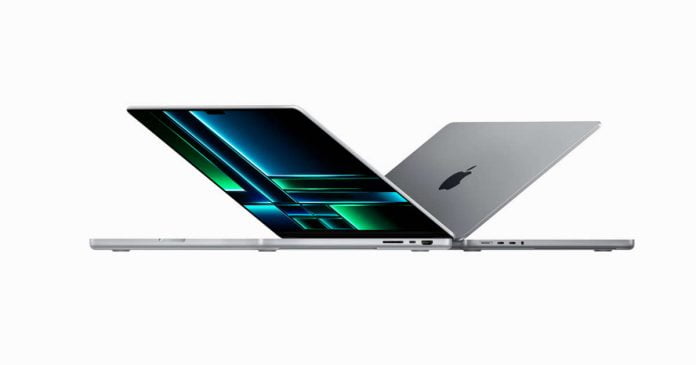
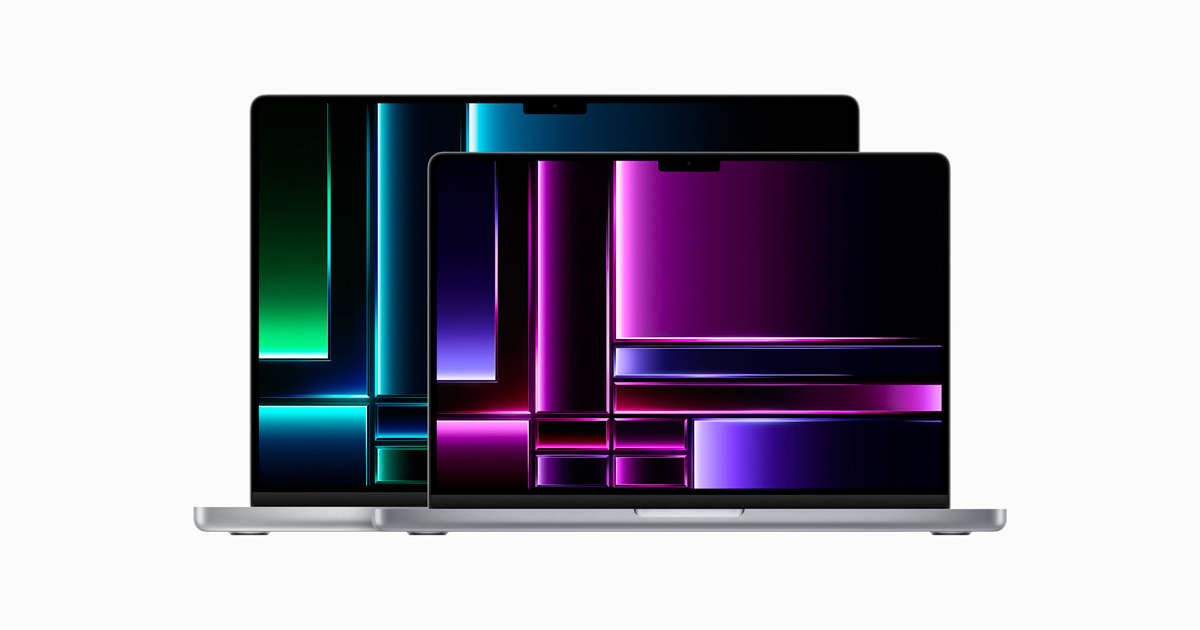
Apple recently released upgraded models of their 14 and 16-inch MacBook Pros along with the Mac mini. These new versions include the newest M2 Pro and M2 Max CPUs, which provide tremendous performance and capability enhancements over their predecessors. 

The new MacBook Pros keep the same Liquid Retina XDR displays with the same top cutout or “monobrow,” as well as a 1080p HD camera. They still include six speakers and studio-quality microphones, but the HDMI port has been upgraded to version 2.1, and it now supports 8K external displays at 60Hz and 4K monitors at 144Hz or even 240Hz.

The new M2 Pro and M2 Max systems-on-a-chip power the 14 and 16-inch MacBook Pros. According to the company, the new versions are six times more productive than the fastest MacBook Pro on Intel. The M2 Pro-based version can have up to 32 GB of LPDDR5 memory, while the M2 Max-based version can have up to 96 GB of LPDDR5 memory.

New MacBook Pro With M2 Pro and M2 Max

The most powerful MacBook Pro can “handle scenes that other laptops and PCs can’t run.” Compilation in Xcode, for example, is 25% quicker than the previous generation, while Adobe Photoshop processing is 80% faster than the fastest Intel-based MacBook Pro. The identical procedure is completed 40% quicker than on the previous MacBook Pro. Furthermore, Motion now renders titles and animations 80% quicker than the fastest Intel-based MacBook Pro and 20% faster than the previous version.

The new MacBook Pros come with three Thunderbolt 4 connections, an SDXC card slot, and MagSafe 3. They also feature a battery life of up to 22 hours and support the latest Wi-Fi 6e module. The M2 Pro and M2 Max processors also provide powerful neural chips with up to 16 cores that can execute up to 15.8 trillion operations per second.

Surprisingly, the supplied MagSafe 3 on the new MacBook Pro now matches the model’s colour. The new laptops are also available with up to 8TB of SSD storage. The 14″ model costs $1999, while the 16″ model costs $2499. The 16-inch MacBook Pro, in its most expensive version, will cost $6499. Beginning January 24th, the new MacBook Pro models will be available for purchase.

New Mac mini With M2 and M2 Pro Processors: More Power and Better Performance at a Lower Price

Mac mini with M2 and M2 Pro

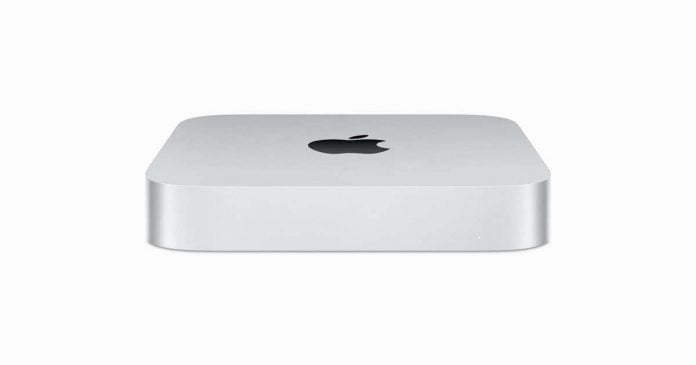
The M2 and M2 Pro CPUs have officially arrived in the new Mac mini, which features the same design as early versions but with significant innovation. The compact computer is also more affordable than ever in its base configuration, giving users more incentive to choose it.

The Mac mini with M2 and M2 Pro is significantly more powerful than previous models. The basic model comes included with an octa-core CPU and a 10-core GPU. According to Apple, the Mac mini with M2 runs Pixelmator Pro up to 22 times quicker than an Intel Core i7 and renders 9.8 times faster in Final Cut Pro. 

The M2 Pro variant has a CPU with up to 12 cores and a GPU with 19 cores. The M2 Pro boasts double the memory bandwidth of the M2 in terms of performance. The M2 Pro boasts 50% better Photoshop performance than an i7 and a Radeon Pro 5500 XT.

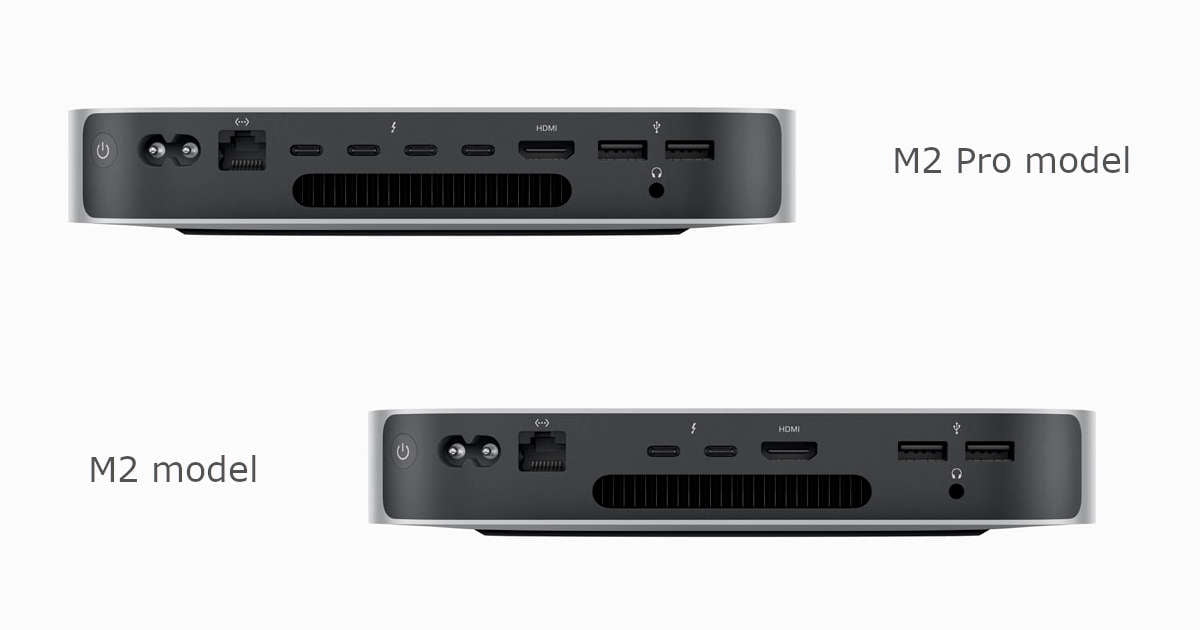
The M2 Mac mini has two Thunderbolt 4 connections, whereas the M2 Pro variant has four Thunderbolt 4 ports and can accommodate up to three displays or one 8K monitor. Both versions have two USB-A connections, an HDMI port, a 10GE Ethernet port, and an authority input. WiFi 6E and Bluetooth 5.3 are also new additions.

Mac mini M2 and M2 Pro

The use of M2 processors allows for unified memory of up to 24 GB with a bandwidth of 100 GB/s, as seen in the MacBook Air. This memory is shared between the CPU and GPU, allowing for more effective use of resources. Furthermore, the Mac mini with M2 Pro supports up to 32 GB of unified memory.

The new Mac mini with an M2 CPU also converts ProRes video up to 2.4 times quicker in Final Cut Pro, up to 50% faster, in particular, Adobe Photoshop tasks, and up to 35% faster in Resident Evil Village. These data provide a rough estimate of how visible the progression is compared to the prior model sold by Apple.

The new Mac mini can now be purchased through the Apple Online Store. The $599 basic model has the M2 chip, an 8-core CPU, a 10-core GPU, 8 GB of RAM, and a 256 GB SSD. The M2 Pro chip’s basic variant, priced at $1299, features a 10-core CPU, 16-core GPU, 16 GB of RAM, and a 512 GB SSD.

The new generation Mac mini is a powerful and small computer that offers superior performance at a cheaper cost than ever before. The new Mac mini is an excellent option for those who want a powerful computer in a small package.

Apple Introduces the M2 Pro and M2 Max Processors: A Look at the Latest Professional MacBook Processors

Apple M2 Pro and M2 Max

Apple recently released new products, including the M2 Pro and M2 Max CPUs. These chips, the expansion stages of the already available M2, are based on Apple’s ARM architecture, Apple Silicon. 

The M2 Pro and M2 Max represent distinct stages of growth, with the M2 Pro supporting 40 billion transistors and the M2 Max supporting 67 billion transistors.

The M2 Pro and M2 Max each have a 12-core CPU. However, the iGPU in the M2 Max has been boosted to 38 cores, compared to the 19 in the M2 Pro. The bandwidth of the unified memory interface has also been increased in the M2 Max, from 200 to 400 GBit per second. The M2 Pro can accommodate up to 32 GB of soldered LPDDR5 memory, while the M2 Max can accommodate up to 96 GB of RAM.

Both SoCs offer hardware-accelerated H.264, HEVC, and ProRes, allowing them to handle multiple 4K streams simultaneously. The M2 Pro uses a video encoding engine and a Prores engine, whereas the M2 Max employs two of each. This implies that the M2 Pro will be utilised in high-performance MacBooks, whilst the M2 Max will be used for more intensive processing workloads and is aimed at media professionals.

Apple also provides some broad performance comparisons for the M2 Pro. The new processor is touted to be 25% quicker in Xcode and 40% faster in photo editing when compared to the M1 Pro. However, Apple has not stated which test techniques or benchmarks were used. Real-world tests will reveal how much more performance the new M2 Pro and M2 Max will eventually provide.

How Technology is Transforming Business

Technology is Transforming Business

The world of business has remained the same, more or less, for centuries after the first industrial revolution, and it’s safe to assume that it won’t happen again anytime soon. The exponential pace at which modern technologies are adapting, mutating, and developing in the last few years has been so incredibly fast that it isn’t hard to get carried away by its wave of advancement and progress—whether or not you’re prepared. 

For those who don’t believe how far we’ve come, only a little over a decade ago, you’ll be surprised to know that we didn’t have voice searches for IoT for information and products, centralized working communications for maximizing efficiencies, and sharing of short-form videos for business purposes, among many more. The reality is that technology has significantly changed nearly every facet of how businesses operate, and nowhere in history did transformations occur so quickly. Below, you’ll find some of the ways in which tech fundamentally changed business.

Artificial intelligence

Artificial intelligence, or AI, has reshaped consumer markets and business, becoming a part of daily life as a result. The technology’s application continues to transform business processes across many industries, becoming an integral strategy for those looking to get ahead or maintain their competitive advantage. For example, through an AI-powered data management platform, it’s possible to process, sort, and find the desired data and transform them into actionable and digestible information to support smart decisions for business. In other words, it can allow you to gain key business insights for success.

The technology can also be used to automate long-standing workflows and repetitive tasks. In this way, it saves businesses time and money on tasks that would otherwise be too repetitive and tedious to be done by a human employee. It also mitigates the occurrence of human error.

Communication and sharing information

Sharing information and communication are critical components of any entrepreneurial venture, and today’s technologies offer many ways now more than ever before. For example, most web conferencing software enables organizations to remain on the same page and stay updated, regardless of proximity time differences. This ensures a harmonious and concordant relationship among all the employees of a company, especially for those working remotely.

Mobile-first environment

These days, you’ll be surprised to find anyone who doesn’t own a mobile device like a smartphone or tablet, and for a good reason. Not only do they possess many of the functionalities of desktop and laptop computers, but they cost much less than they do too. Moreover, they’re handy and can be easily brought anywhere. For this reason, they’ve become the preferred devices of consumers when it comes to finding information, making purchases, and sharing retail experiences with the rest of the world.

This presents businesses with the unique opportunity to attract more customers, be it through mobile apps or website optimization. And because they’re practically handheld computers, it’s possible to use them for many business-related functions too.

Conclusion

Many businesses today rely heavily on technology because it enables them to operate as efficiently as possible. And as technology continues to evolve, the dependence of companies and brands on tech is likely only going to get stronger. Businesses that fail to capitalize on the advantages it offers will only miss out on opportunities to grow and succeed.

Samsung Exynos 2200 Outperforms Qualcomm Snapdragon 8 Gen 2 in Ray Tracing Tests

Samsung Exynos 2200

Samsung introduced its new Exynos 2200 mobile processor with hardware support for ray tracing technologies around a year ago. This was a big breakthrough since it was the first smartphone SoC-supported hardware-accelerated ray tracing. However, because there were no comparable benchmarks, it was not feasible to test the performance of this functionality until now.

But, owing to the recently launched In Vitro GPU programme, we can now glimpse the Exynos 2200 chip’s full capabilities. The findings are in, the Samsung processor outperforms the top-tier Qualcomm Snapdragon 8 Gen 2 platform in ray tracing tests.

According to the research, the Exynos 2200 outperforms the Snapdragon 8 Gen 2 in average and lowest performance, while the Snapdragon 8 Gen 2 outperforms it in maximum performance. This is an important discovery since it demonstrates that the Exynos 2200 may perform better in the most demanding applications.

It’s also worth noting that the Exynos 2200 was launched about a year ago, but this feature has been neglected throughout that period. This is likely due to a lack of appropriate games and benchmarks allowing users to fully appreciate the Exynos 2200’s hidden capabilities. However, now that the In Vitro GPU test has been released, we can see that Samsung’s processor is a strong platform.

The AMD Xclipse 920 GPU used in the Exynos 2200 appears very strong in ray tracing settings. This is an important achievement for Samsung since it demonstrates that its processor can outperform Qualcomm’s freshest and finest.

Samsung Unveils Revolutionary ISOCELL HP2 Camera Sensor with 200 Million Pixels for Upcoming Flagships

Samsung ISOCELL HP2 camera sensor

Samsung just introduced its new ISOCELL HP2 camera sensor, which features 200 million pixels, for upcoming flagship smartphones. 

According to the company, this sensor will provide the greatest high-definition experience on premium devices. Though it was not explicitly stated in the press release, this new sensor is most likely to be included in the company’s future flagship smartphone, the Galaxy S23 Ultra. The Galaxy S23 Ultra is scheduled to be unveiled on February 1st at the Galaxy Unpacked event.

The ISOCELL HP2 sensor measures 1/1.3 inch and features 200 million 0.6 micrometres (μm) pixels. The sensor size is the same as the 108MP sensor, which implies that the camera bump will not get too huge. Furthermore, the ISOCELL HP2 sensor enables many pixels binning choices, capturing photographs at full resolutions of 12.5MP, 50MP, or even 200MP. The increase in the number of pixels also implies that employing AI will enhance the noise caused by the decrease in the light-receiving area per pixel.

The new D-VTG (Dual Vertical Transfer Gate) technology will considerably improve image quality by suppressing overexposure in bright situations. A voltage transfer gate on the bottom of each photodiode in the ISOCELL HP2 transports electrons from the pixel to the logic layer. D-VTG creates a second transfer gate within the pixel, boosting the pixel’s full-well capacity by more than 33%. It is feasible to prevent overexposure, especially in intense light, and enhance colour reproducibility by storing more electrons and effectively conveying information.

When shooting in 50MP mode, Samsung’s Dual Slope Gain function automates each pixel’s exposure data in two phases, gathering both bright and dark data. Furthermore, “Super QPD,” which employs all 200 million pixels as a focusing agent, enables high-speed autofocus in poor light conditions.

In conclusion, Samsung’s new ISOCELL HP2 camera sensor is a technological marvel that promises to deliver an unparalleled high-definition experience on flagship smartphones. The upcoming Galaxy S23 Ultra will likely be equipped with this sensor, and we can’t wait to see the stunning images it will capture.