Home Blog Page 281

A Complete Guide On How To Recover Deleted Data On Mac

Recover Deleted Data On Mac

Do you have some important data on your Mac that you want to recover? Wondering how you can do this process and if it is possible? If you have the same questions like these, then this is for you. This post will show you ways on how to recover deleted data on Mac computer.

Mac is one of the most trusted brands when it comes to computers because of its high-quality performance and amazing features. Selling Apple products also brings good value. That is why a lot of people tend to have this computer. And also, Mac comes with a large storage space that will allow every user to save as much data as they want as long as they do not reach the limit of its space.

However, just like any other computer, accidents also happen to a Mac product. And one of the most common scenarios that most users experience is losing their important data on their Mac. And with that, a lot of users are having the question if there is a way for them to recover those deleted data on their Mac.

Well, the answer to that question is yes. There are several ways on how to recover deleted data on Mac. And these methods are known to be very easy that you can do it on your own. So, to know more about the ways on how to recover deleted data on Mac, go ahead and keep on reading this post.

Part 1: How to Recover Deleted Data on Mac Using FoneDog Data Recovery

In this first method that we are going to show, it does not matter if how the files from your Mac got deleted or the reason behind it. The FoneDog Data Recovery is a third-party app that you can use in order for you to know how to recover deleted data on Mac the safest, easiest, and quickest way possible.

Through the use of the FoneDog Data Recovery, you will be able to recover deleted data on your Mac such as your audios, emails, photos, documents, videos, and more. Through this tool, you will be able to recover even from the Recycle Bin of your Mac. And aside from that, you can also recover lost or deleted data from other external devices such as your flash drive, external hard drive, and memory cards.

The FoneDog Data Recovery software is as we said, very easy to use. So with that, we are going to show you here a quick sample on how the process flows.

Step 1: Select Data to Recover and Storage

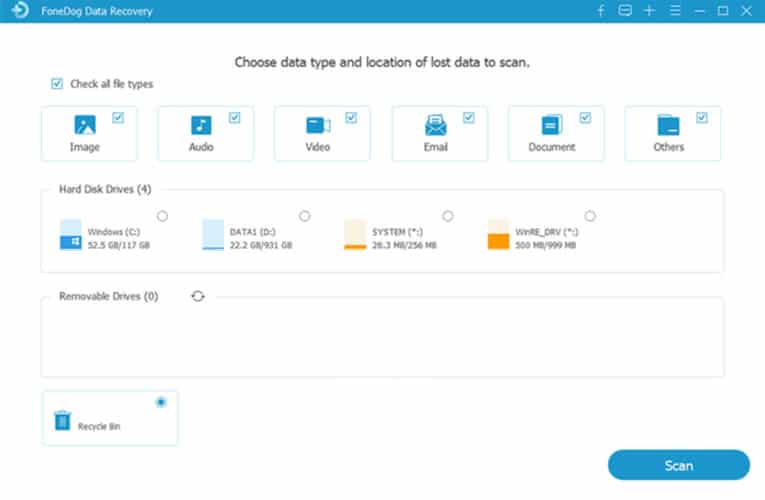
Download and then have the FoneDog Data Recovery installed on your Mac. Once done with that, launch the program to start using it. Then, once that you get on the main page of the tool, simply choose the type of data that you would like to recover. And also, on the same page, choose the location of the data where it has been deleted.

Recover Deleted Data On Mac

Step 2: Do A Complete Scan on Mac

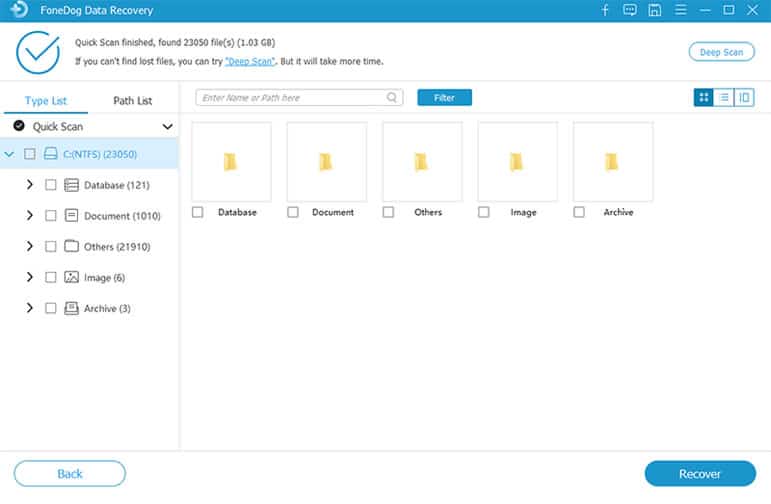
After choosing all the needed information, the next thing that you should do is to have your Mac scanned by the FoneDog Data Recovery. For the scanning process, there are two ways on how the program can scan your Mac. One is through a Quick Scan which can take only a few minutes. The other one is through a Deep Scan which can take a longer time to complete. But it can definitely give you more items that you can recover as a result.

Recover Deleted Data On Mac

Step 3: Check Your Scanned Data and Choose to Recover

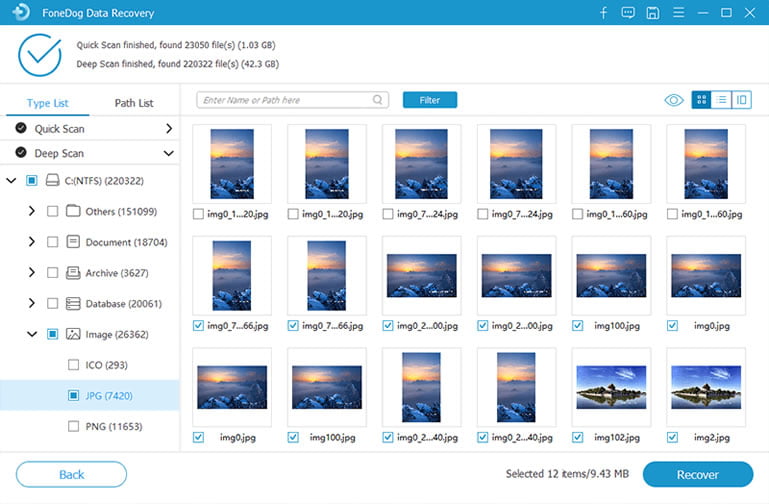
After the scanning process, you can now go ahead and choose the data that you want to recover. By doing this, the FoneDog Data Recovery will allow you to preview your scanned data. This way, you will be sure that you are going to select those data that you really want to get back.

Recover Deleted Data On Mac

Step 4: Recovery Your Chosen Data

And once that you are done choosing the items that you wish to get back, you can now go ahead and process recovery. In order for you to do this, just click on the Recover button found at the lower right corner of your screen. Then wait for the program to complete the recovery process of your deleted data on Mac.

Part 2: How to Recover Deleted Data on Mac Using Recycle Bin

The easiest way for you on how to recover deleted data on Mac is by taking advantage of its Recycle Bin folder. This is because every file that you have deleted on your Mac, whether you have dragged it to your trash or by clicking on the delete button, they can all be found in just one folder which is the Recycle Bin.

Data that was put on your Recycle Bin can still be restored with just a few clicks.

  • Step 1: Launch your Recycle Bin on Mac.
  • Step 2: Locate on the file or data that you want to restore.
  • Step 3: Then right-click on the data and then choose the option Put Back. This will then recover your chosen data back to the original folder where it has been deleted.

Part 3: How to Recover Deleted Data on Mac Using Time Machine

In some cases, there are those users who try to empty their trash now and then. This means that once that you have deleted all the items that you have on your Recycle Bin, then you can no longer recover them using the method above.

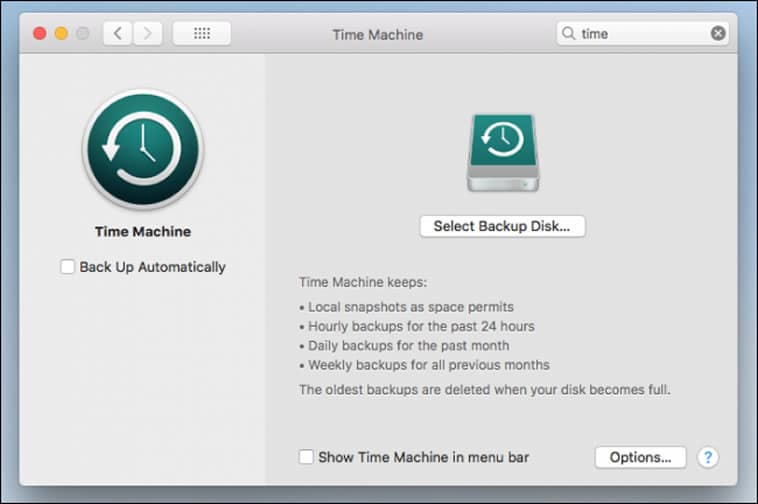
Good thing is that there is also another way for you to recover those deleted data using a built-in feature on your Mac. And this is by using the Time Machine Backup files. And to show you how you can do that with this method, here is a quick tutorial that you can follow.

  • Step 1: Go ahead and click the Spotlight option which can be found at the upper right hand of your Mac. Then enter Time Machine for you to locate and launch it.
  • Step 2: Then, from the page of Time Machine, go ahead and choose the folder where you have lost your data that you want to recover.
  • Step 3: After that, go ahead and hit on the arrow up button which is located at the right part of the Time Machine page. Then go ahead and check out all the backup files shown on your screen and then choose the one that you would like to recover.
  • Step 4: Once done, simply press and hold the Command button and then select on the file that you want. After that, click on the Restore button for you to recover deleted files on Mac using the Time Machine.
Recover Deleted Data On Mac

Part 4: How to Recover Deleted Data on Mac Using Undo Options

There are also some Mac users who are very tidy that they always deleted those files that they no longer need from their Mac. This way, they can keep their Mac clean while they are using it. And because of that, there are some people who lose their data because they have accidentally deleted it.

If you have this same case, then you have the option for you to recover that deleted data right after you have accidentally deleted it from your Mac. And this method is by using the Undo option. You can have that file be restored on your Mac immediately right after you have accidentally deleted it. However, this will not work if you have already emptied your Recycle Bin.

Part 5: How to Recover Deleted Data on Mac Using Terminal

Another feature that you can use on your Mac is its Terminal app. This is an app wherein it is considered to be a direct interface to your OS X. That is why you can make use of it if you want to restore deleted data on your Mac computer. And in order for you to know on how you can use this, here is a quick process that you can follow.

  • Step 1: Go ahead and navigate to your Applications and then click on Utilities for you to be able to launch your Terminal app.
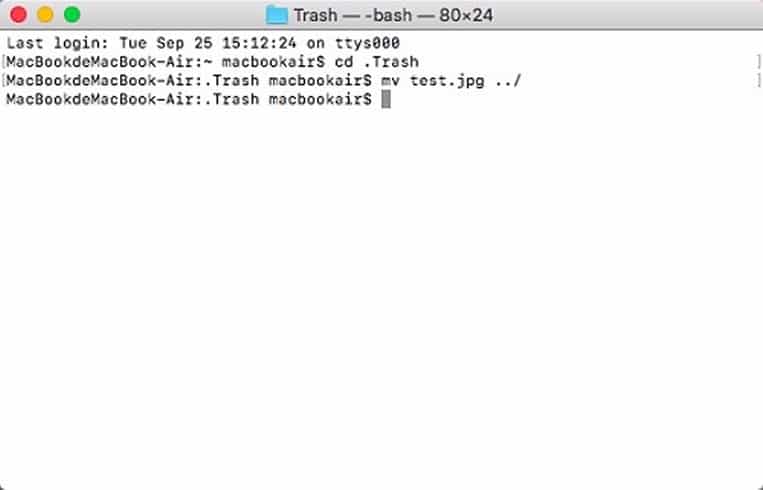
  • Step 2: From there, go ahead and key in the Unix code: cd .Trash and then tap on the Return button n your keyboard.
  • Step 3: After that, type in mv name ../ and then press the Return button again. In this command, you can change the command “name” with the name of the file that you would like to recover.
  • Step 4: After that, type in Quit after you have recovered the data that you want and to close the Terminal app on your Mac.
Recover Deleted Data On Mac
Conclusion

As you can see, there are definitely a lot of ways on how to recover deleted data on Mac. The only thing that you need to do here is to choose which of the following is suitable for what you really need. However, if in any case that you want to do this process the easiest and the fastest way possible, then you might as well use the FoneDog Data Recovery to get back those deleted data on your Mac.

Do we need to get kids their own Headphones?

Bluetooth headphones for kids

Kids these days play a lot of video games and the noise coming from the console creates a bit too much irritation. Whether it’s a continuous battle scene or a car racing, the sound continuously hitting our eardrums causes a great deal of frustration.

Most of us prefer to hand over the kids a gaming device so they stop coming back to us and remain engaged themselves. It is a bit on the negative side of the attitude of parents but it is still prevalent. Now, with kids enjoying themselves with these mobile phones and gaming consoles, a problem of noise pollution arises in the home.

Kids do have a tendency to get too much involved in the gaming environment and he is already not listening to your shouting that says to keep the volume low. The only solution we can find for your mental peace is you need to buy the latest Bluetooth headphones for kids.

Bluetooth Headphones for Kids? Are you kidding me?

Even talking about Bluetooth headphones for kids is insanity, right? It might have been the case but now specialized headphones are designed for the usage by young ones. You might be worried about the hearing capabilities being affected in the long run but it is no more the concern.

You get to set the maximum sound intensity they can hear through Bluetooth headphones. Most usually it is set to 85db as recommended by the experts so, you’ve got rid of this concern quite easily. Next, you need to prioritize how effective these Bluetooth headphones can be used.

It is quite a pity that we don’t optimize the use of technology for the kids. Handing over to them the mobile phones and other gadgets is solely to avoid giving attention to them. There are some great learning opportunities over the internet, and if you prioritize those personalized lessons for kids, BlueTooth headphones for kids can come quite handy.

They can listen properly to the poems, interactive stories and build a more deep sense of the things evolving around them. The material has always been there at the platforms but we are not including them in our priority.

Since the negative impact is more commonly observed, we get deceptive about something that is really helpful. In the end, if we analyze, it would be our own attitudes to be blamed. At a young age, there is much higher curiosity and we need to set the right triggers for them.

Obviously, you can’t hand over the things without effective monitoring, you still need to keep your eyes open. We have to use these online platforms to their maximum potential. Most of the things are free for us to consume and it can be a great way to build a foundation. Kids would get to know about the use of technology in a more positive way and guided exploration will prevent them from going astray out of curiosity.

These Questions Will Help You Choose the Right Data Visualization Tool for Your Business

Data Visualization Tool

Data visualizations have become a key part of how organizations understand the mountains of data they produce daily. As a major component of business intelligence (BI) platforms, or on its own, a good data visualization tool can greatly amplify the insights you gain from your data – and help with comprehension and alignment across your teams.

After all, nearly 65% of people consider themselves visual learners, and we can process massive amounts of data with our eyes in seconds. Moreover, companies that use visual data discovery and visualization tools are almost 30% more likely to identify relevant, game-changing information than those that don’t.

However, not every data visualization method is as useful as the next in any given situation, and different organizations have unique needs that make for specific requirements. Choosing the right set of tools for your company is an important consideration, and before you decide, there are several aspects to consider.

Here are some of the big questions you need to answer before you can make sure you’ve chosen the right data visualization solution for your company.

1. What Kinds of Queries Does Your Organization Need Addressed?

Although all organizations produce data, the information they generate is unique and offers different insights based on what questions are being asked. While it’s true that all professional-grade data visualization tools will give you a clearer picture of your operations, there may be some that are more optimized to your specific industry or market segment.

However, the first step is to understand what you want to learn from your data visualizations. Are you looking for quick reporting that measures KPIs and displays them easily? Or, are you looking for drill-down analysis that comes with more customizability and the ability to create deeper visualizations? Is your organization more focused on historical data, or are you looking for predictive analysis?

These questions will frame the type of visualizations you need and the tools that can provide them for you.

2. How Tech-Savvy Are Your Team Members?

Data visualization and BI tools today run the gamut from easy, out-of-the-box solutions to fully customizable suites that are built for rugged analytics and more focused approaches. However, these two ends are meant for significantly different organizations with vastly different levels of technological capital and skill.

Smaller organizations may not have the available budget for an analyst-based data visualization tool that requires dedicated operators and heavy coding. On the other hand, some companies may have specific needs that require a more in-depth tool.

Understanding your team’s skill level is also crucial, as complex tools may lose some of their value if they aren’t properly configured or used. Before choosing a data visualization tool, it’s worth auditing your organization’s technological capital to understand both your constraints and your needs.

3. How Much Data Do You Use, and How Is it Stored and Formatted?

This is another important consideration to have. While almost every company collects data from hundreds of touchpoints across their operations, they don’t all use it or store it the same way.

For some companies, data can be used largely historically—that is, without any demand for minimized latency. This means that data can be parsed, prepared, and optimized for visualizations long before they reach end-users. On the other hand, some organizations require large amounts of data processed and visualized on the fly, often in the form of KPIs, sales metrics and other transactional information.

This largely affects how you keep data and store it, whether in a data warehouse, lake, or other structure. More importantly, it also changes the range of analytics and visualizations you can apply and the purpose of your visualizations. If your organization uses reports and dashboards extensively, you may require visualization tools that combine both current and historic data. On the other hand, if you’re mostly performing analyses on past transactions, you may not need auto-refreshed dashboards and visualizations.

4. What Kinds of Visualizations Do You Need?

The Last important factor to consider is the type of visualizations that best fit your company’s data profile and needs.

Again, you’re the specifics of the organization will largely define the type of visualizations work best, even if it’s more than one or two. However, there are some major data visualization types that are most commonly used:

  • Hierarchical visualizations such as tree diagrams and ring charts are great for studying data clusters that span from a single point and can show relationships in data more clearly.
  • Geospatial visualizations show your data along geographical lines and can be excellent to understand sales trends, logistics, and supply chain bottlenecks.
  • Multidimensional visualizations give you different ways to interpret and compare data sets to find new correlations.
  • Network visualizations are excellent at finding the ways datasets connect to each other, and how they interact.

These are just some of the most popular types, but your organization may use one or more of them. Based on what you need, it may be worth exploring different tools.

Visualize Your Business’s Success

The right visualization tool is not a single answer, but rather the result of a better understanding of your company’s data needs. By taking the time to consider the right data visualization tools you need to match both your existing capital and your requirements, you can ensure that you’re getting the most out of every visualization you create.

Profit Generation Online With a Jobs Website

coding developer

In a flawless combination of relatively low competition and high turnover, job board sites are currently one of the most popular money-making online websites to build. Few other types of websites are more profitable than job board sites, however, they are highly saturated with established giants taking up a huge portion of the market share.

E-commerce, business websites, and blogs are all saturated genres with very little room for entrance and even less for expansion. If you are new to the business of building websites, then a job board site is the perfect place to start.

What is the job board site?

A job board site is a website used by employers to advertise/publish their job vacancies as well as aiding employees in navigating the labor market space and applying for jobs. In other words, a job board site or employment website is an online labor market where employers and employees interact.

Is building a job board site profitable?

Yes. With few competitors and excellent profit margins, the building of a job board site is a profitable venture. Glassdoor one of the leading websites in the job board genre is worth more than $1.2 billion. That is a testament to the huge profitability and potential in building job board sites. Nevertheless, the existence of only a few big fish in the sea still leaves a lot of space for new entrants as a lot of niches are left untapped.

Job posting charges, premium package, membership fees, sponsored posts, etc. are some of the numerous means by which job board sites generate revenue.

How to create a job board site

Beyond coding and website building specific knowledge on how to create a job board website becomes necessary. Make sure your job board site is a real problem solver and connects employers with employees. Your job board site must be friendly to both sides of the market. This balance, however hard to achieve is the deciding factor between failure and success.

A detailed surf, through already established job board sites, would give you an insight into some of the key properties necessary to achieve success. Creating a successful job board site can be divided into two spheres.

  • Satisfying the employers.
  • Satisfying employees.

There is a wide range of features that you must add to your website to ensure that these two spheres are well balanced. Examples are employee profiles, dashboards, job searches, etc.

Despite user-friendliness, and useful features being the master key on how to create a job board website there are a lot of other aspects to be considered. Marketing, pricing, customer care, frequent updates, and security to name a few.

Conclusion

Creating a job board site isn’t a walk in the park, however, with the colossal number of websites filling every genre and niche, job board sites serve as one of the most fertile ground to plant. It is important to understand that building a job board site is the first step, but regular improvement and maintenance is the full journey. With careful execution and keen attention to details, your job board site should be successful.

Choose the Galaxy Note 10 for business

Choose the Galaxy Note 10 for business

You’ll want to make sure you’ve got the right phone for work so choose the Galaxy Note 10 for business. You’ll get some of the best speeds, designs, and features with it!

What really makes a good business phone? There can be hundreds of components such as how it works, what it supports, or even something as specific as the ringtones available. Among many other reasons, this is why the Samsung Galaxy Note 10 is perfect for business.

Professional Design

The first thing you’ll notice about the Note 10 is the 6.3-inch all-screen, Dynamic AMOLED display. This is slightly smaller than it’s successor, the Galaxy Note 9 however, there’s nothing to complain about! You’ll be able to see more than before as the phone’s bezels have been removed. By removing these, Samsung gets to keep hold of its extremely sleek, high-end appearance whilst giving customers more of what they want.

You will definitely want to snatch up a case for the new Galaxy Note 10 as Samsung has chosen to keep the all-glass finish however, they are offering the phone in two gorgeous colors. Whether you’re looking for a traditionally professional impression, you’ll be able to purchase the Aura Black phone. For those looking for something a little more exciting, the brand-new Aura Glow option is your best bet.

Samsung’s Magic Wand

Ever had the issue of pressing more than one button on your phone at a time? Well, Samsung’s S-Pen solves that issue. These pens come with each phone, included in the price, and will make working from your phone ten times easier! For someone looking for a stylus, you’re going to want to choose the Galaxy Note 10 for business.

Each year, the S-Pen gets a new revamp, allowing you to do far more than before. There’s so much this little S-Pen can do from taking photos, signing documents, or taking notes quickly. The pen itself slips into a small hole in the bottom on the phone. If you’re sitting in a meeting without a notepad, you’ll be able to quickly jot down all the important parts without even unlocking your phone!

What’s under the hood?

Running on Android 9.0 Pie, upgradable to 10.0, you know your phones in safe hands. You’ll have access to all your favorite apps such as Google Documents, Google Maps, and access to the Google Play Store. Samsung realizes you need plenty of storage for your emails and work documents, that’s why the Note 10 is available in 256GB with 8GB RAM. If you do find yourself needing more storage than this, the Note 10 Plus is available in 512GB with expandable memory.

A great feature that keeps the Note 10 going is it’s 3500mAh, non-removable Li-Ion battery. You’ll find that this phone keeps you powered up through your working day so you never miss a moment. If you do find yourself needing a quick boost, you can make use of Samsung’s fast charge. Pop your phone on charge whilst you have a coffee and you should be ready to go for the rest of the day.

For every businessperson, there’s a huge importance on creating a professional image and that’s one of the biggest reasons you should choose the Galaxy Note 10 for business.

Could Coronavirus Lead to More Working From Home?

useful gadgets for remote education

It’s reasonable to assume that the COVID-19 crisis that’s recently hit the business world is going to leave a lasting impact on virtually all businesses.

Sadly, many will not be able to weather the economic storm that’s surrounded the pandemic – but for those who have a business model that’s been able to adapt, it’s almost certainly relied on employees working remotely.

Hopefully, we won’t see a pandemic of this nature again – but if we do, will we be better prepared? And could we shift more of our workforces to remote positions to safeguard our businesses?

What kind of changes will businesses need to make?

As many businesses rush to make it possible for employees to work from home, we’re getting a better idea of what’s needed to make sure your business can be run safely, securely, and effectively under employees’ roofs.

Generally speaking, it’s IT systems that prevent people working from home in many roles, so it’s a good idea to look at what kind of IT infrastructure is needed to make working from home a more realistic proposition.

An internet connection

Above and beyond all other considerations, your remote workers are going to need a way to connect to your network.

Fortunately, more and more businesses are opting for cost-effective 4G network designs that can be adapted to allow for 4G (and soon 5G) routers based in other geographical locations.

The good news is, many 4G and 5G routers are becoming capable of carrying multiple SIMs – which mean business-level data connections, even if you’re working from a property that only has a domestic internet circuit installed. These highly portable routers are simply used too. Generally, a router will be set up by an IT provider on-site, meaning they’re ready to be fired up at home and ready to use.

There’s little technical knowledge required either – so you don’t have to worry about employees being especially well-versed on network security. In fact, connecting to the network created by the router would be very similar to connecting to an office-based wired connection.

A remote desktop

Although bring your own device policies have some merits, there’s nothing that really compares to the concept of sitting down in front of a work machine and accessing all your familiar applications and systems – and this is where a remote desktop is enormously helpful.

A remote desktop service means you can access your work machine from anywhere you can get a suitable internet connection – and since the machine you’re working with is ‘virtual’ – you don’t run into any of the security issues that you would if you simply brought a work device home and used it on your own network.

A communication system

In the absence of being able to talk across the office to coordinate your working day with the rest of your team, it’s useful to have an application that keeps you in touch.

This is where a service like Slack comes in handy. Rather than rely on multiple conversations in your email inbox, you can set up a workspace and invite your colleagues. When they arrive, they’ll find a virtual workspace, where you can set up different conversations about projects – including as many of your colleagues as you wish – and even limiting access to certain topics if you want to set up different departments or contractors on the system.

Communication tools like this reduce the chance of workers feeling disconnected from the team – and while they’re not a perfect substitute for standing around the copier having a quick chat, they do have their merits. It’s shown that collaborating online is likely to increase a team’s productivity by around 10% – which isn’t to be sniffed at.

A cloud-based CRM

Being able to securely access all the information a business holds about its customers can be the difference between being able to support and sell to those customers or not.

A good CRM system can be used to organize every interaction you have with every customer – and even potential customers. In fact, it’ll help you maximize every interaction you have – and since it’s cloud-based, you’re not relying on your employees being able to pick up paper files in your office.

Studies suggest that this ultra-efficient electronic way of handling leads will send conversion rates through the roof too. Some industries report 300% increases in customer conversions simply because they implement a CRM rather than relying on a suite of other applications.

The good news is, customers tend to approve too. From their point of view, the experience only ever gets better – and, as a result, some industries report 70% increases in customer satisfaction – simply because interactions become more streamlined and effective.

Working with freelancers, contractors, and third parties

Of course, a huge percentage of the world’s workforce already considers home as their primary place of work – so having employees working from home doesn’t have to just involve sending your current staff home with routers – it can also mean you open your doors to people who already have the work-from-home infrastructure in place.

If you’re relying on recruiting people who can commute to your office, you’re narrowing your talent pool significantly – whereas having a remote working infrastructure in place means you can open the door to talent from the other side of the world should you so desire.

This also means being able to outsource your IT support too. Increasingly, companies are turning to managed service providers (MSPs) for their IT requirements. It’s useful to think of a managed service provider as an external IT department – but without the legwork and cost required to recruit an in-house team.

By working with a remote IT team, you unlock a huge amount of technical knowledge and potential. For your monthly cost, you’re likely to get round the clock support (without having to employ people around the clock!) and a world of knowledge that’s honed on hundreds of other company’s IT provisions. If you’ve got the infrastructure in place to work with a team remotely, IT is a great place to start – and if you don’t have that provision just yet, a good remote IT team can help you put it in place.

Securely Send Essential Data Over Internet By Hiding Files In An Image Using CMD

Hiding Files In An Image Using CMD

Did you ever wonder, if there is any way to send or store our private or secret files without encryption, like hiding them in some secure location where no one ever guesses? Then you are going to love this trick.

The practice of hiding files in an image is known as Steganography — used when someone wants to send important data over the internet without using any encryption or decryption method.

Suppose, if you want to email a classified document or a secret file securely without encryption, then concealing them inside an image is the best option. Apart from transferring files over the internet, we could use this method to hide our personal files on the computer without raising any suspicion.

Now you may think, what happens if someone gets those image files with our hidden data? — Don’t worry, even if someone stole or compromised our data, they can’t extract the actual file hidden within that image without knowing the exact trick and also image acts normally as it should. In some case, like if you hide a large file inside an image then the abnormal file size of the image file gives away the trick.

As we know Command Prompt is the most powerful tool in Microsoft Windows, ironically uses rarely. Here, we are using the power of CMD to hide files in the image.

Hiding files in an image using CMD:

First, we are going to sort out the files to hide in a separate folder. So create a new folder anywhere on your computer. And remember its path:

Like, here I created a new folder in my F: drive and its path is “F:\New folder“.

Now copy all the files you want to hide and paste it in that new folder. Next, you have to compress those copied files and after that add an image file to the same folder — in which we are going to hide that compressed file. Also, rename the files for ease of access in CMD.

Hiding Files In An Image Using CMD

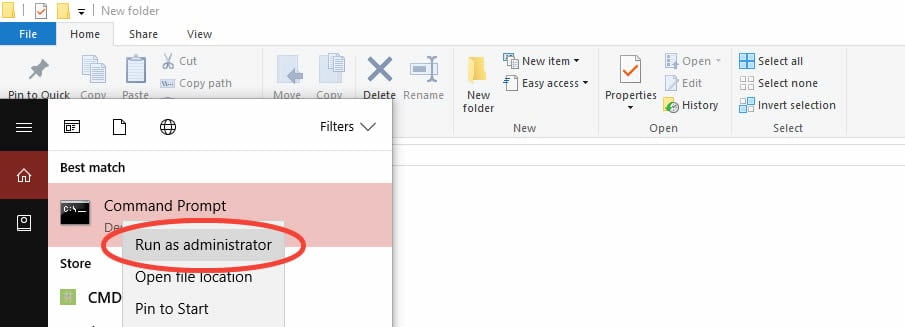
Now we are going to play with some CMD commands. Run Command Prompt with administrative privileges.

Hiding Files In An Image Using CMD

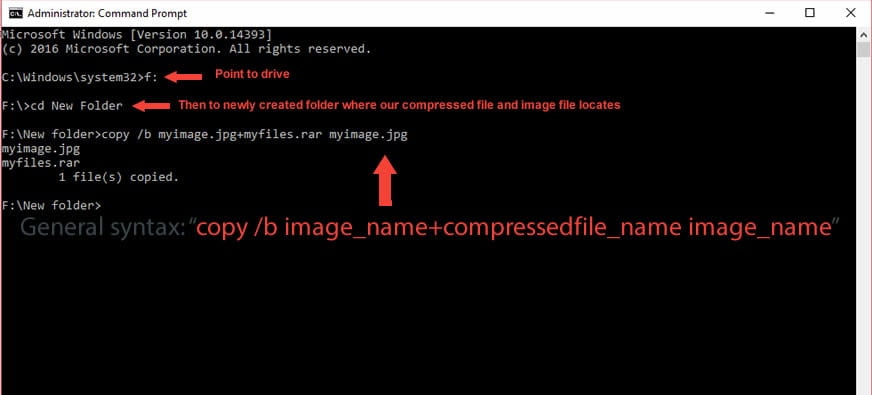
In CMD, first, we are going to navigate to that New Folder that we created earlier.

In the above image “F:” is the drive where I created the “New Folder.” Then I directed the command prompt to “New Folder.”

With next CMD command, we are going to hide files in an image. So type this command carefully —

General syntax: “copy /b image_name+compressedfile_name image_name” and hit “Enter”.

Don’t forget to use full name of the files (include file extensions too). For example in my New Folder, name of the image file is, “myimage.jpg” and name of that compressed file is “myfile.rar”, so my command is going to be —

copy /b myimage.jpg+myfile.rar myimage.jpg

Hiding Files In An Image Using CMD

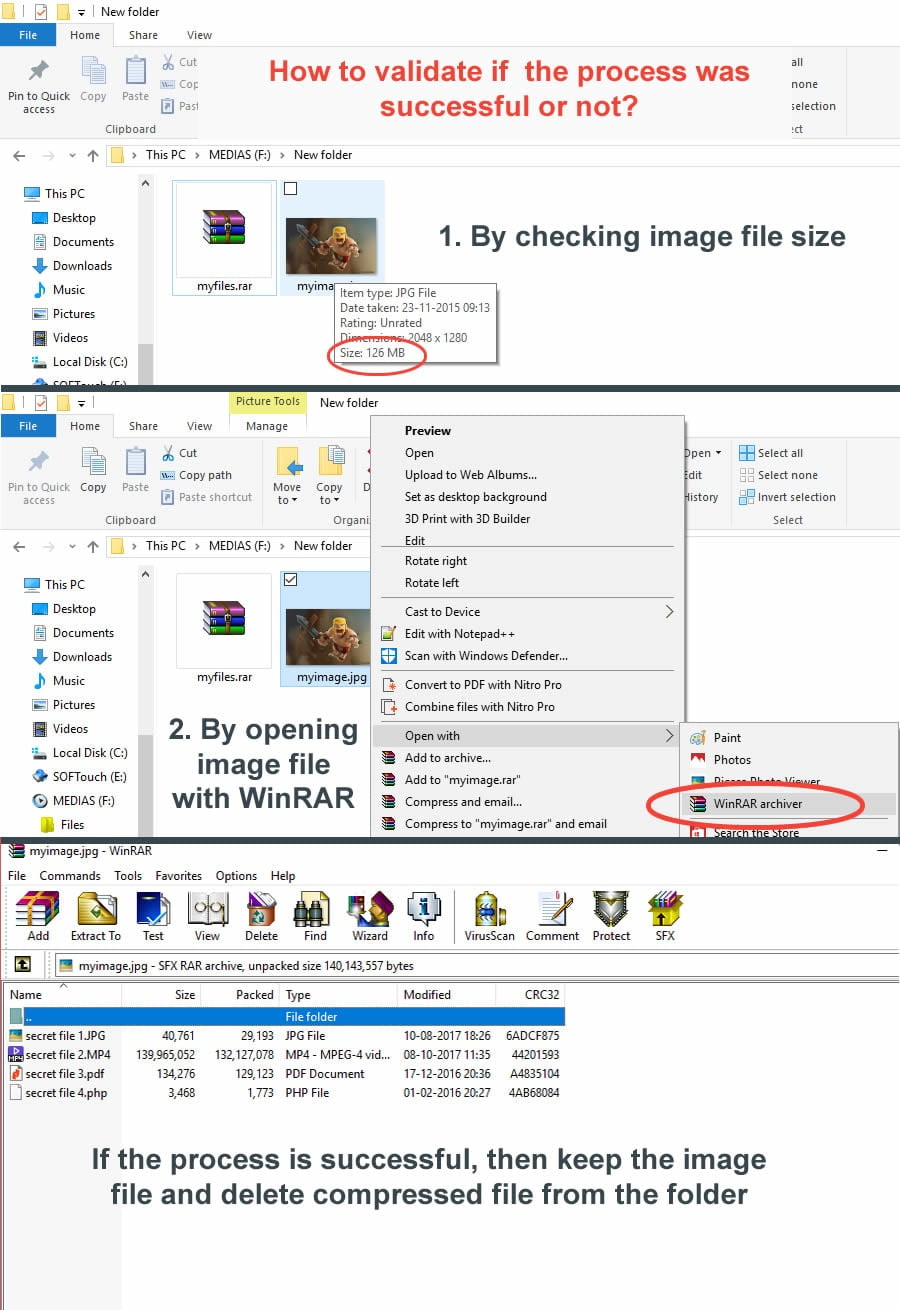
That’s it! We successfully hide our secret files in an image. You can validate if the process was successful or not either by checking the image file size or by opening an image with WinRar or WinZip. If the process was successful, then delete the original compressed file.

Hiding Files In An Image Using CMD

How to extract hidden files in an image? — As we already mentioned, you can extract files inside the image by simply opening it with WinRar.

What Is Signal Jamming And How Does It Work?

Signal Jamming

For quite some time, the topic of signal jamming has been exclusively discussed on warfare forums and was only popular with a very specific audience. This took a complete turn, however, as technology continued to move forward with time. Especially with the rise of the use of mobile phones (fun fact: did you know that there are an estimated 3.5 billion smartphones in the world as of 2020?) technology supporting its services and functions has also blown up, one of which is signal jamming.

But what exactly is signal jamming and how does it work?

Signal jamming is the deliberate blocking and disruption of wireless communications. It’s a method that is used to mess with information flow and, in extreme cases, are used as a form of censorship.

The use of signal jamming can be traced as early as World War II. The method was utilized back then by ground radio operators to mislead pilots by transmitting false instructions, and governments used it as a way to stop its citizens from listening to radio broadcasts against their propaganda. At present, signal jamming is still used by the People’s Republic of China wherein the government plays broadcasting music (commonly Chinese folk music) to block broadcasting from stations like Radio Free Asia and Voice of Tibet.

Wave interference Explained

Wave interference plays a very important role in signal jamming. To understand it better, imagine throwing two rocks at still water. When you throw them at the same time, they create separate waves which, after meeting together, join to create a bigger wave. The same also happens for other waves like electromagnetic waves and sound waves.

Each wave comes with a corresponding frequency—to put simply, the number of times it pulsates. When a wave peaks and meets another wave which is also at its peak, it creates constructive interference which creates a new wave. However, when a wave trough merges with another wave trough, they automatically cancel each other and end up creating destructive interference instead.

The Science of Signal Jamming

Learning how wave interference works is important in understanding signal jamming. Consider a smartphone as an example, a gadget with a frequency that ranges between hundreds of megahertz to a few ones. Signal jamming a cellphone needs a destructive interference pattern with its radio waves. To do this, jamming devices have to flood a space with a radio wave that matches the phone’s frequency. Doing so will then create a white noise type of wave that can mess with the phone’s waves. When this is successful, any smartphone within the affected radius of that device will not receive any signal.

What is signal jamming used for?

Signal jamming may sound complicated, but it is actually quite useful for both consumer and government use. For example, many signal jammer devices are often used in prison centers to block possible sending out of messages from inside the area to the outside world. Since mobile phones are quite easy to smuggle inside prison facilities, there is a high chance that inmates can use it to communicate externally and create situations that can put witnesses and other civilians in danger.

Some types can be used to block signals of bombs and are commonly used for situations like VIP protection or prisoner transport, too. Military jamming equipment focused on this work by preventing detonation of improvised explosive devices, for example, by producing electronic countermeasures.

Of course, signal jamming gadgets can also be used for personal reasons as well. Everyone who has a smartphone has probably experienced getting annoying phone calls, something which a gadget like this can ultimately solve. Signal jammers for mobile phones mostly work to cover limited areas only—there are even portable models that you can take with you while you are on the move so you can protect yourself wherever you go. The Signal Jammer has several options of devices that can serve your needs, whatever they are.

Legal Issues

Many countries like the United States and the United Kingdom have set rules that make signal jamming against the law. In the U.S., specifically, smartphone jamming falls under the Communications Act of 1934 which cites that it is illegal for individuals to “willfully or maliciously interfere with the radio communications of any station licensed or authorized.” Importing, manufacturing, and selling of such devices are also deemed illegal.

For countries like this, using signal jammers equate to property theft, since blocking the signal in an area with a radio spectrum bought by a company is the same as stealing said property. Moreover, irresponsible jamming of signals can also be a safety hazard since it can affect other devices and get in the way of urgent information sharing.

On the other hand, some countries allow the use of signal jamming devices among government organizations and even private businesses. The reason behind this exception is because signals can pose more threats or interference to the operations of these agencies. Several examples are movie or concert theaters. Other countries make exceptions for the use of these devices during special events well.

Before purchasing a signal jamming device, it is necessary for the consumer or organization to verify first the legal restrictions of using it in their areas. In the U.S., fines, and prosecution for signal jamming are handled by the Federal Communications Commission which can either set a fine as high as $11,000 for a violation, or imprisonment for a year.

The low-down on signal jamming

Signal jamming doesn’t really have a clean image, especially with the history of the purposes for which it is used back then. However, that doesn’t mean that it doesn’t have any benefits. Looking at it with an unbiased point of view, it can bring as much good as it can with the bad.

It can block helpful signals for protection or it can also pose a risk when used for the opposite.

In the end, it is up to the user to practice responsible use of it and to make sure that it will only be used for legal reasons.