Home Blog Page 211

The Modern Mobile App Market: Telehealth apps for Physical Therapy

Telemedicine apps

According to Reports and Data, the global market for mobile health apps will reach nearly $312 billion by 2027. It is easy to explain the growth in popularity – it is both the increase in the general level of concern for one’s health and the accessibility of receiving doctor’s advice through apps. Telemedicine apps make it possible to avoid serious medical errors: a common cause of incorrect diagnoses is ineffective communication between doctor and patient. 

Where is telemedicine used in healthcare? 

Telemedicine technology can be used in almost any medical field, be it pediatrics (a sick child no longer needs to see a doctor), psychotherapy (psychotherapists conduct sessions online), dermatology (thanks to high-quality images, dermatologists can examine patients suffering from psoriasis, eczema, bedsores, etc.), neurology (remote monitoring of blood pressure values is redirected to a specialist), physical therapy (special apps can control physical therapy) or intensive care (in situations where a person cannot be moved to another clinic, urgent video interviews are carried out by a specialist).

With the development of telemedicine, people save time and effort because they can talk to a specialist online. This is relevant for people living in megacities, who often do not have enough time to monitor their health and sit in queues. But telemedicine technology is also an option for people living in rural areas because highly qualified doctors work in cities.

Telemedicine technology can also be used during emergencies (hurricanes, floods, earthquakes). When Hurricane Harvey hit Texas in 2017, medical professionals set up video conferencing with specialists in other states for those people who were slightly affected. This relieved the burden on Texas doctors, who took care of patients with severe injuries first.

Another way telemedicine technology has been used is through remote medical offices. For example, the American retailer Walmart has installed points with computers in many of its stores, which can be used to get in touch with a doctor. The patient enters his symptoms, enters a virtual waiting room, and consults with a specialist by video.

But today let’s talk about telehealth apps for physical therapy. There are a lot of commercial companies or clinics that develop special telehealth software for physical therapy. With the help of such apps, you can find needed exercises for physical therapy. Below are the best telehealth apps for physical therapy.

Freeletics Training Coach

It is one of the most popular physical therapy applications. It contains exercises with your own weight, which you can perform where you want. You can choose from ready-made physical therapy programs or create your own. It is also convenient that each therapy exercise is accompanied by video tips that explain how to perform it correctly.

Seven

Here, physical therapy exercises last seven minutes a day. The developers claim that Seven’s physical therapy programs are based on scientific research and provide maximum benefit to the body in the shortest possible time.

The app works out your physical therapy program for the week in different categories: general and dynamic. Seven has more than 200 physical therapy exercises of varying difficulty levels, and video instructions for them. The app is suitable for people with busy schedules.

Thenx

It contains physical therapy exercises and programs, but some may require equipment. Proper execution is shown in videos by professional rehabilitologists. Therapy exercises vary in difficulty and user preparation.

Sworkit Lite

Quite a handy program for therapy exercising with a lot of exercises. The user needs to select the type of therapy workout, specify the time, and the screen will show videos with the rehabilitator who demonstrate the set of exercises. The app reminds you of your therapy workouts every day.

iMuscle 2

The iMuscle 2 lets you choose which body part you want to rehabilitate using a 3D model of a person. Once the user clicks on the picture, the app will find the right therapy exercises. You can create personalized therapy programs according to your goals and needs. All materials are available offline, and each therapy exercise is accompanied by an animated picture.

FitOn

FitOn has a huge advantage over competitors – instead of animations demonstrating how to do this or that therapy exercise, it uses recorded videos with professional rehabilitators. Moreover, the user is not shown individual exercises, but the entire therapy workout consisting of 10-20 minutes of movements.

Conclusion

Often people are much more comfortable exercising at home, doing therapy exercises with basic equipment. But not everyone can independently think up and form a therapy plan. Special telehealth applications for physical therapy help with this, they tell what to do, how many times, and how long. The main thing is not to forget that the application itself will not exercise for you. Now you know the best telehealth apps for physical therapy.

Oppo Plans To Develop Its Own Processors For Its Smartphones In The Future

Oppo Plans To Develop Its Own Processors

This week we saw, Google gave a capital importance to the fact of being able to use its own processor in new Pixel 6 and Pixel 6 Pro smartphones. Tensor has become the central element of their new mobiles. Similarly, Apple and Samsung bet on their own processors to launch better performing flagships. And now it looks like Qualcomm could soon lose another customer — Oppo plans to develop its own chip for its top smartphones.

The company belonging to BBK Group integrates Qualcomm chips in its high-end smartphones and MediaTek in the mid-range and input terminals.

According to a new report from Nikkei Asia, Oppo is currently developing its own processors, and everything indicates that they will be ready for smartphones launched from 2023 or 2024. According to this, TSMC’s 3 nm process should be used and would be designed for the brand’s flagships. There are no details about the processors yet.

Qualcomm is unlikely to be satisfied with the current development in the smartphone chip market. In mid-October 2021, the company posted a tweet complaining that Google is installing its own chip.

https://twitter.com/Snapdragon/status/1448317606365179906

Although, apart from using its own SoCs, Samsung continues to use Qualcomm chips in numerous models, and Oppo also wants to use its own processors only for certain top-end models. Qualcomm is unlikely to be pushed out of the market in the foreseeable future.

Goodbye To Facebook: Mark Zuckerberg Plans To Rebrand The Company With A New Name

Facebook branding

According to a rumor, Facebook plans to change its company name next week to reflect its focus on the metaverse.

The reason for the renaming, which The Verge claims to have heard from an informant, is to reflect the company’s product diversity. CEO Mark Zuckerberg plans to announce this at the annual Connect conference on October 28.

The new name is kept in strict confidence. Not even all members of the management know it. It is speculated that it may be related to Horizon, the company’s new product, unveiled in August. This is a network of virtual offices that you can connect to via video conferencing or using the Oculus VR headset.

According to a source, The Verge reports, the name change is intended to signal an expanding field for the tech giant. Facebook wants his name to be associated with more than just social media.

Apparently, the rebranding should help position Facebook as just one of many products from the firm that also controls Instagram, WhatsApp, Oculus and several other companies.

Facebook didn’t comment on the rumors.

Mistakes To Avoid When Building Your Small Business Website

business website news and stories

To spread the word about your new small business, you want to design a great online home. If you’ve never created a professional website before, you may not know what blunders to avoid.

Sensory Overload

Rather than packing every page of your website with visuals, colors, and text, aim for a clean layout that’s easy on the eyes. If you’re starting your digital presence, learning how to create a website from scratch could be beneficial. Decide what message you want to convey on each page of your site, then choose the most efficient way to deliver that message. Site visitors should understand what your business is about within the first few seconds of visiting your website. If they can’t perceive that while being bombarded with a busy site design, they’ll likely check out your competitors.

Lack of Visual Interest

Just as you don’t want too much going on, you also don’t want to underwhelm site visitors. Minimal site design can look great, but only when done with a deft hand. To avoid this, ask yourself what information website visitors need to understand your company and how you can improve your customers’ lives. You don’t want to leave room for misinterpretation or guessing. 

No Call To Action

What do you want visitors to do when they’re browsing your site? Common calls to action include learning about a product or service, getting a coupon or discount, and clicking a specific link. Whatever you want visitors to do, make it plain with a succinct and direct CTA.

Lack of Brand Image

All text, images, typefaces, color palettes, themes, and flat icons on your site should flow together. Mismatch any of these design elements and you may confuse potential customers. Keep this from happening by selecting a single design template, conveying a few distinct ideas, and understanding your brand image. If possible, carry this cohesion over to your social media business profile and everywhere else your business appears online.

Incorrect Use of White Space and Content

Focus just as much on your website’s content as you do its layout. Poor use of content and white space may drive visitors away from your site the same as a lack of visual interest and sensory overload. For content, concentrate on a typeface that’s easy to read and looks great on the screen. As for white space, break up content with blank space. That way, you give the reader’s eyes a break and make blocks of text less intimidating. Using visual elements instead of words to convey your concepts also makes content a joy to read and experience.

Poorly Updated Site

Don’t take a set-it-and-forget-it approach with your site. Even if your products or services change very little, regularly update your website. Most of today’s shoppers connect with businesses for the first time through the company website. If yours looks like a relic from the past, your target audience may become skeptical about your company and the services or products you offer. Let your site make a great first impression by keeping it current. 

Not Working With Professionals

As you can see, there’s a lot to creating and managing a commercial website. You could use some professional help to bring out the most in your business’s online home. Web hosting professionals can design, maintain, and market your site for you. You can use free web hosting services and tools, but that could cost you if you don’t know how to maximize those services and tools. Paying for professional services costs money, but it could earn you more money, too.

Learning what to avoid and what to focus on for your small business website helps you save time and maximizes your company’s potential. Use these tips to your company’s advantage.

Pixel 6 And Pixel 6 Pro: Google Smartphones With Tensor SoC And Unique Design

Google Pixel 6 And Pixel 6 Pro

Google has officially presented its new Android smartphones, Pixel 6 and Pixel 6 Pro. With these two flagship smartphones, Google heralds the departure from Qualcomm and instead relies on its own chip, Tensor. An SoC that bets heavily on artificial intelligence — optimized in particular for AI-supported tasks.

The smartphones, on the other hand, have a completely new design, new cameras, larger batteries and Android 12.

Google Tensor

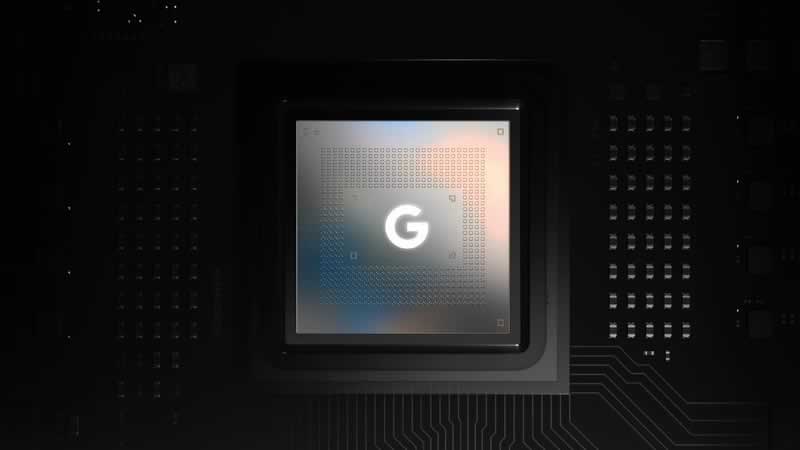
The biggest novelty of the Pixel 6 smartphones, without a doubt, is Tensor, the first SoC designed by Google. According to their data, the Tensor CPU is 80% faster than the previous generation chip, which will be reflected in the overall performance of the system. For its part, the GPU is up to 370% faster.

Google Tensor

The CPU of this Google Tensor, by the way, has a slightly peculiar configuration. First of all, it has two high-performance Cortex-X1 cores, a strange figure considering that other processors like the Snapdragon 888 only have one of this type — probably not to spike power consumption or keep the heat generated by it at bay. Alongside these two cores are also two medium-performance Cortex-A76s. The strange thing is that these cores are inferior in several ways to the Cortex-A78.

In addition to standing out in terms of performance and consumption, Tensor also pays special attention to security. Tensor works in conjunction with Titan M2, a chip specifically designed to enhance security. Google has also committed to providing security-focused software updates for the next five years.

Google Pixel 6

The standard Google Pixel 6 is the smallest of the family. It mounts a 6.4-inch panel in Full HD + resolution, with a refresh rate of 90 Hz. The panel’s LTPO technology allows an intelligent refresh rate, which adapts the hertz to what we do on our smartphone to save battery life.

Google Pixel 6

It is accompanied by 8 GB of RAM and 128 or 256 GB of internal storage. The 4,614 mAh battery has a 30W wired fast charge via USB-C (the charger is sold separately), and it also has wireless fast charging. In terms of resistance, it is IP68, and Gorilla Glass Victus certified.

Moving on to the photography field, the Pixel 6 has a dual-camera whose design will not go unnoticed since the module extends from side to side. It incorporates 50 MP sensors (main with f/1.85 aperture) and 12 MP (ultra wide-angle with f/2.2 aperture).

The company clarifies that, in the case of the first sensor, its dimensions were increased to capture more light. Up to 150% more, to be exact. Thanks to this, the Pixel 6’s computational photography system will have more data to improve the level of detail of the images. Regarding the front camera, we find an 8-megapixel sensor with a field of view of 84 degrees.

Pixel 6 can record at 4K resolution and 60 frames per second, which in turn will be complemented by Auto-HDR. You can capture video in slow-motion at 240 fps and 1080p resolution.

On connectivity, support is offered for the already common 5G, Wi-Fi 6E and Bluetooth 5.2.

Google has managed to take advantage of the interior space to integrate a larger battery. Its capacity is 4,614 mAh, which, together with the optimization of the hardware and software provided by Tensor, promises an improved battery life.

Pixel 6 offers up to 3 colors in 3 combinations of tones — green with turquoise, coral with pink and black with gray. Its basic version will cost $599 in its 8 + 128 GB variant.

Google Pixel 6 Pro

Google Pixel 6 Pro mounts a gigantic 6.7-inch screen in QHD resolution with an OLED LTPO panel with a refresh rate of 120 Hz. Again, the front camera is embedded in the upper part, although in this case, the screen frames are much more used, and the edges are curved, reminiscent of the Samsung Galaxy Note.

Google Pixel 6 Pro

It includes the same benefits to charge other devices via wireless charging. Storage now includes 12GB of LPDDR5 memory with 128, 256 or 512GB of UFS 3.1 storage and the same connectivity, with Wi-Fi 6E and 5G.

Google Pixel 6 Pro features 3 different sensors — the same 50-megapixel sensor that we have already seen in the Pixel 6, as well as the 12-megapixel ultra-wide-angle sensor and the autofocus laser. It has also mounted a new 48-megapixel telephoto sensor capable of four-fold lossless digital zoom. The front camera is 11.1 megapixels, with an aperture of F/2.2 and with a field of view of 94 degrees.

The battery, in this case, happens to be 5,003 mAh, and like the standard Pixel 6, it has both fast wireless charging and 30W wired fast charging.

It will arrive in 3 color versions along with Android 12, also with their respective color combinations — white and gray, yellow and orange, and black and gray. It will arrive on October 28 at a price of $ 899 for the basic version of 12 GB of RAM and 128 GB of internal memory, somewhat lower than alternatives such as the iPhone 13 Pro, which costs $999.

The Tensor chip enables the two new pixel models to have functions such as the Magic Eraser. This automatically removes disruptive elements such as power lines or people who do not want the user to be in the picture. The Magic Eraser is a pixel-exclusive feature.

We also see the Super Res Zoom, a zoom that can reach up to 20 by in the Pixel 6 Pro and Live HDR+, a processing algorithm to get photos and videos in HDR with higher quality. In addition to all this, we also have Live Translate, which allows both voice and text to be translated almost instantly in real-time.

According to Google, the new Pixel smartphones will receive Android version upgrades and new functions for three years.


Apple M1 Pro and M1 Max: All-New MacBook Pro Comes With A Huge Performance Leap

Apple M1 Pro and M1 Max

Apple has presented its new proprietary M1 Pro and M1 Max chips on its Unleashed event, the first to be manufactured for its computers intended for professional users. 

With the M1 Pro and M1 Max, the new MacBook Pros in 14.2 and 16.2 inches are the first notebooks to be upgraded from last year’s M1. Twice as many performance cores meet clearly drilled GPU. There are also more RAM and SSD options, more connections, MagSafe, and mini LED displays with 120 Hz.

M1, M1 Pro, and M1 Max

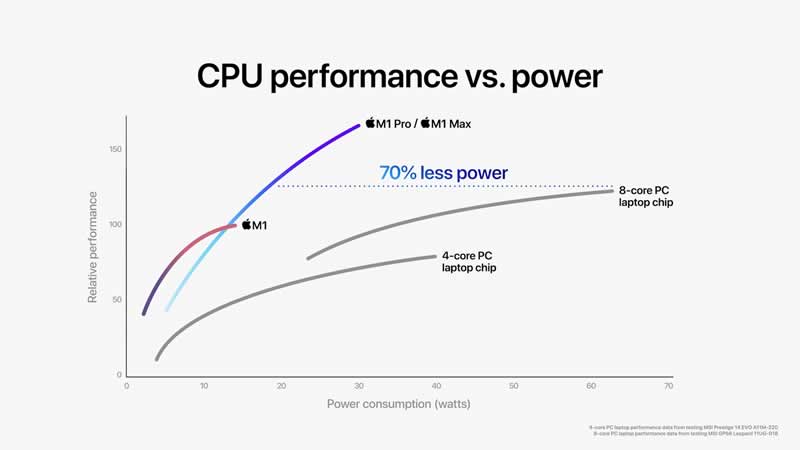
Regardless of whether AMD, Intel or Nvidia hardware, with the M1 Pro and the M1 Max, Apple is preparing to outdo the assembled competition. The company ensures that both the M1 Pro and the M1 Max give a performance 1.7 higher than that of a PC with an eight-core chip from the competition.

Apple M1 Pro

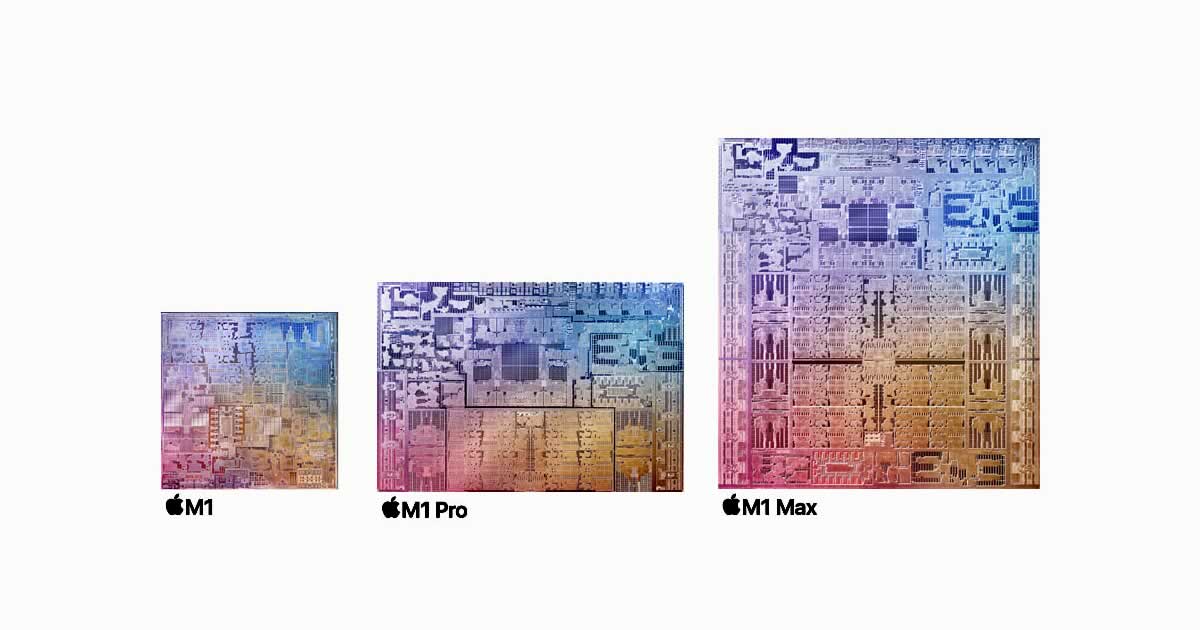
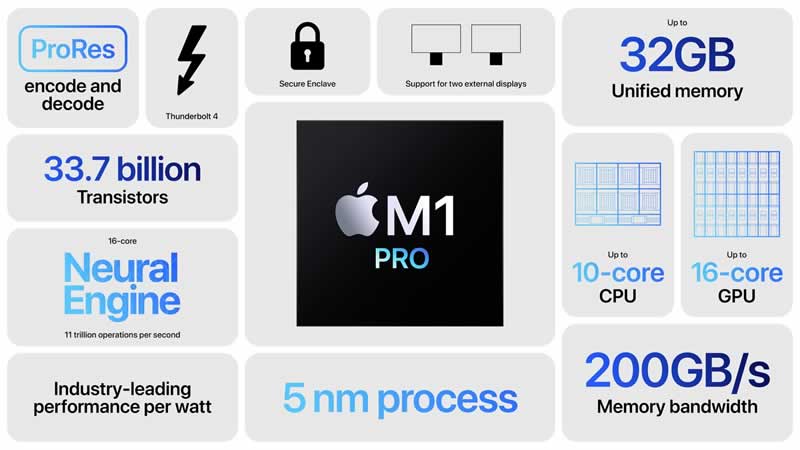
While the M1 previously had 4 performance and 4 efficiency cores, the new M1 Pro has up to 8 performance and 2 efficiency cores. Apple has also tripled the memory bandwidth to 200 GB / s and doubled the maximum amount of memory supported to 32 GB according to the newer LPDDR5-6400 standard.

Apple M1 Pro

SSDs up to 7.4 GB/s speed can be selected with up to 8 TB. The new CPU is supported by a GPU doubled from 8 to 16 cores, which has up to 2,048 execution units and a performance of up to 5.2 TFLOPS. The M1 Pro also offers a new media engine for hardware-accelerated decoding and encoding of H.264, HEVC, ProRes and ProRes RAW. There is a decoding and an encoding engine as well as a ProRes encoding and decoding engine. The M1 Pro comes from 5 nm production and has 33.7 billion transistors.

A smaller variant of the M1 Pro with only 8 CPU and 14 GPU cores was not mentioned in the stream, but this can be found in the technical data of the MacBook Pro 14.2.

Apple M1 Max

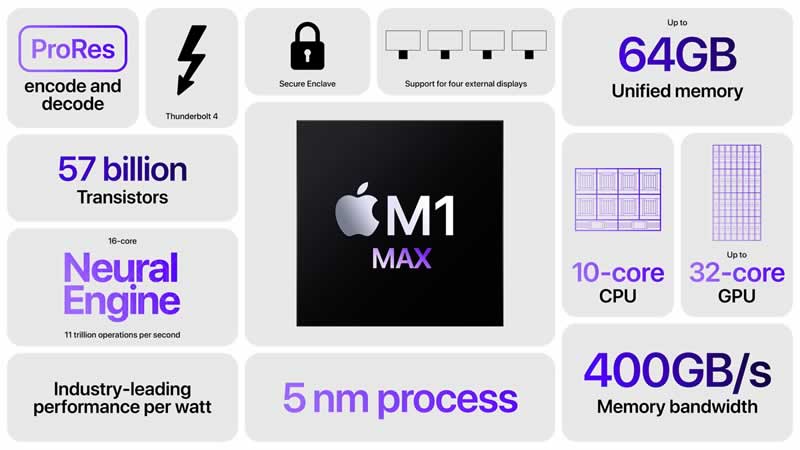
Above the M1 Pro, the company positions the M1 Max with 57 billion transistors from 5 nm production. The CPU resembles the full configuration of the M1 Pro, but the additional die area flows into a GPU that has again been doubled to up to 32 cores with up to 4,096 execution units and up to 10.4 TFLOPS performance.

Apple M1 Max

At 400 GB/s, the chip’s memory bandwidth is six times the level of the M1 and up to 64 instead of 32 GB LPDDR5-6400 come next to the die. The media engine, which in the M1 Max still has one decoding, but two encoding and two ProRes encoding and decoding engines, has also been drilled out further.

Similar to the M1 Pro, smaller models of the M1 Max were not mentioned in the stream. Apple always offers the more powerful SoC with the same CPU but differentiates the GPU in variants with 24 and 32 cores.

MacBook Pro

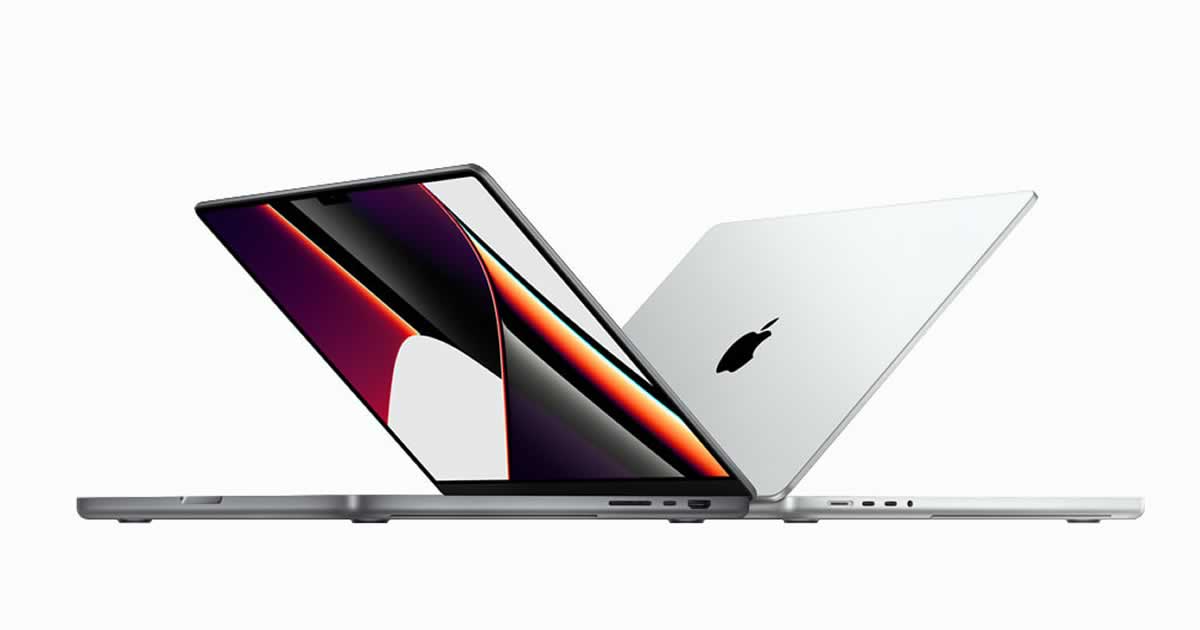
With regard to its aesthetic redesign, the new MacBook Pro arrive in sizes of 14 and 16 inches, they do so with a very high-resolution screen thanks to mini-LED technology and that takes more advantage of the front with narrower frames and a notch where it houses a 1080p camera. Also, a better keyboard that says goodbye to the Touch Bar and the most connectivity to date on a MacBook Pro.

Apple M1 Pro and M1 Max MacBook Pro

The extreme SoC performance is designed to facilitate 3D artists’ work in 8K greatly, and doing extremely heavy tasks previously unimaginable on a laptop. In addition, they will do so without sacrificing battery life, since the new chips allow them to offer up to 17 hours of video playback in the 14-inch model (that is, 7 hours more), while the 16-inch model reaches 21 hours of playback, that is, 10 more hours.

Apple M1 Pro and M1 Max performance

The thermal performance is also accompanied by its internal design. Apple explains that its new aluminium casing precisely surrounds an advanced thermal system that can displace 50% more air than the previous generation, even at low fan speeds.

In the new case, you also have the most connectivity ever seen in a MacBook. Both models come with three Thunderbolt 4 ports for connecting high-speed peripherals, an SDXC card slot, an HDMI port, an improved audio jack compatible with high-impedance headphones and the new generation of MagSafe that now sports a new design.

In addition, for the first time on the Mac, you can use fast charging, which allows you to reach 50% charge in just half an hour. With the M1 Pro chip, users can now connect up to two Pro Display XDRs, and with the M1 Max, up to three Pro Display XDRs and a 4K monitor all at once.

The new MacBook M1 Pro and M1 Max equip a Liquid Retina XDR display that, thanks to the mini-LED technology already used in the iPad Pro , provides up to 1,000 nits of sustained brightness at full screen, 1,600 nits of maximum brightness and contrast of 1,000,000:1.

In addition, the screen of this new Mac includes ProMotion technology, with an adaptive refresh rate of up to 120 Hz. ProMotion is the system that automatically modifies the refresh rate to adapt it to the content that the user has on screen and thus help preserve the battery.

Regarding availability and price, the MacBook Pro models with M1 Pro and M1 Max are pre-order now and will be available starting Tuesday, October 26. The 14-inch MacBook Pro starts at $2,249, and the 16-inch MacBook Pro starts at $2,749.

Important Programming Languages Used By Ethical Hackers

Programming languages for Hackers

Which is the important programming languages for hacking? — Since hackers do not use a single programming language. They use different coding dialects for different projects.

Earlier we discuss top operating systems for hackers, today we are here before you to give some information about important programming languages of hackers used for ethical hacking.

Coding is essential for hacking because a hacker is someone who breaks a system protocol or application security which is programmed in a certain programming language. In order to understand the working and find vulnerabilities of a machine and applications, a hacker must learn a couple of programming languages to complete his task. So check out the important programming languages for hackers and security experts and where to apply it.

Programming Languages of Hackers:

There are lots of computer languages but few are required for hacking purpose because in most cases it depends upon target. There are basically three sections ― Web Hacking and Pentesting, Exploit Writing & Reverse Engineering and each of it requires different coding.

Programming languages for Web Hacking and Pentesting

If you’re interested in web hacking and pentesting, then you must learn learn below mentioned languages at-least basic and intermediate level.

1. HTML

Always begin with basics and HTML — HyperText Markup Language — should be the first one you should learn as a beginner. HTML is the building blocks of the internet and an ethical hacker should know it very well to understand web action, response, structure, and logic. Also, learning HTML is not at all that tough.

2. JavaScript

JavaScript — JavaScript is the most used as client-side programming and for web development is also the best programming language for hacking web applications. In fact, it is the best programming language for hackers and security experts for developing cross-site scripting hacking programs.

You should learn it on high priority mode. Understanding JavaScript code logic can help you find the web-apps flaws and it is the best one to manipulate both front-end and back-end web components.

3. SQL

SQL — Structured Query Language — is a database programming language used to query and fetch information from databases. All big and small websites and web apps are using databases to store data like login credentials and other valuable inventories — it is the most sensitive part of the Web. So a hacker must learn SQL to communicate with databases and to develop hacking programs based on SQL injection.

4. PHP

PHP is the most popular dynamic programming language, used mainly by websites build upon popular CMS like WordPress. So knowing PHP will help you to find vulnerabilities in such network and take down a personal website or blog. Hackers use PHP mainly for developing server hacking programs as it is a server-side scripting language. So, if you are into web hacking then deeper knowledge in PHP is necessary.

5. Perl

Perl is an important programming language for hacking to compromise old machines since many old systems still use Perl. Perl is worth learning for practical reasons — it’s very widely used for active web pages and system administration, best available language for manipulating text files on Unix systems and integration with popular web-databases. So that even if you never write Perl you should learn to read it.

Programming Languages for writing Exploits

Exploit writing is an advance part of hacking. It requires a higher level of programming language. Every professional hacker must know to exploit writing. It can be done in any programming language like C, C++, Ruby, Python, etc.

6. C

The mother of all programming language, C is the most important programming language used in creation for Linux and Windows. So learning C programming will help an ethical hacker to understand the way of working of these systems — like how CPU and memory interact with each other.

However, it is the best programming language for exploit writing and development. The low-level nature of C benefits security experts to develop hacking programs to access and manipulate system hardware and lower level resources.

7. C++

C++ is one of the best programming languages for hacking software comes under a proprietary license and require paid activation. Like C, C++ also gives the low-level of access to the system and helps to analyze the machine code and bypass such activation schemes. Also, many modern hacking programs are built on C++.

8. Python

Unlike any other programming language listed here, Python is the easiest one to learn. It is the most used language for exploit writing as Python is the easiest programming language to write automation scripts because of pre-built libraries with some powerful functionality.

Also “run without compilation” nature of Python makes its an essential programming language for hackers to take down web servers. It is highly recommended you to learn Python Socket Programming because it helps lot learning exploit creation.

9. Ruby

Ruby is a simple but complicated object-oriented programming language used in web development. Ruby is very useful in exploit writing. It is used for meterpreter scripting and do you know Metasploit Framework itself programmed in Ruby.

10. Java

Java is the most widely used programming language in the coding community. Java was originally released with the slogan “write once, run anywhere,” which was intended to underscore its cross-platform capabilities. Because of that Java is the perfect programming language for hacking PC, mobile devices and web servers.

You can make tools using Java and it can also be used to create backdoor exploits as well as exploits that can kill a computer. Once you write your hacking programs with Java, you can run them on any platform that supports Java.

11. LISP

Lisp is the second-oldest high-level programming language in widespread use today. LISP is absolutely wide open, flexible and totally machine independent makes it hacker’s favorite. You can define your own syntax and create any sort of programming paradigm you like and include it in your programs.

Programming languages for Reverse Engineering

Reverse engineering, also called back engineering, is the processes of extracting knowledge or design information from anything man-made and reproducing it or reproducing anything based on the extracted information. Reverse engineering is also beneficial in crime prevention, where suspected malware is reverse engineered to understand what it does, and how to detect and remove it, and to allow computers and devices to work together. Reverse engineering can also be used to “crack” software and media to remove their copy protection.

12. Assembly Language

Assembly is low level programming language but very complicated. One can instruct a machine hardware or software using Assembly language. Reverse Engineers uses Assembly language, and if you want to learn Reverse Eng, you must need to learn Assembly language.

Finally one more thing, programming languages for hacking also depends upon what program you want to hack, for example; if a web-app in coded in ASP.NET then you can’t hack it using PHP knowledge, although you can understand logic but it will be harder, so always make sure what you wanna hack and in which programming the app is coded.

Also hacking is a skill and only talented well-trained could become a better security expert. So learn these programming languages to its core and hard-train your abilities to solve different coding problems.

So tell us which programming languages do you know and which one are you going to learn soon ? We’d love to hear from you in the comments!

Nothing Could Launch Its First Smartphone In 2022 After Its Partnership With Qualcomm

Nothing Partnership With Qualcomm

It looks like OnePlus co-founder Carl Pei’s company Nothing is really getting ready to enter the smartphone market. 

According to 91mobiles, Nothing is preparing to launch its first mobile phone early next year. This is also indicated by the recent announcement of Nothing’s partnership with Qualcomm. Also, at the beginning of the year, the company acquired the failed Essential, which was created by Andy Rubin.

Nothing’s deal with Qualcomm has many advantages. The first is Nothing’s access to Qualcomm’s entire portfolio of processors and chips, including those that grant the ability to have 5G. And if a company wants connectivity that can operate with each other, this is undoubtedly an essential requirement.

The point is that Nothing gave no clues as to which products it was going to use Qualcomm’s chips for and limited itself to saying that for “future technological products.” This clearly opens the door for Nothing to decide to use them on smartphones or even tablets.

Considering the design of the first product, Ear (1), the appearance of the smartphone will probably becomes with an eye-catching and attention-grabbing design. Perhaps it will be the most unique smartphone in 2022.

According to report, Nothing will release its first external battery, Nothing Power (1), and it will be released before the smartphone.