Home Blog Page 173

What to Look For in Due Diligence Solutions

Due diligence software

Due diligence software, also known as workflow management, is a tool for automating routine tasks and providing a more comprehensive view of the people and businesses involved in transactions. It is a cornerstone of any modern business that seeks to compete in the markets as they exist now.

A robust due diligence solution can help companies perform due diligence more efficiently by automating routine tasks. For example, it can be used to review thousands of documents quickly and easily by searching for relevant keywords across multiple file types, including emails. 

The results are sorted into folders according to who they’re from or where they were sent: investors in a company, employees at another company that’s been acquired or merged with yours—or even your own personal email account if you’re on the board of directors at one of those companies mentioned in the software.

But choosing a due diligence solution is quite a task. You need to review your business needs and their engagement with a country’s laws. If you’re an international company, you have to think about international law as well. To make this task a little bit simpler, we’ve put together a list of traits that set of traits that are inimical to due diligence software, so when you’re checking the features, you’ll know what to look for.

Data Collection

Data collection is the first step and most important step in due diligence because it enables you to meet your due diligence needs. AI is the best solution for data collection because it’s faster than human-based data collection, more accurate than human-based data collection, and more cost-effective than human-based data collection.

AI also eliminates some of the challenges that come along with manual data collection (like language barriers) by using a combination of machine learning algorithms and natural language processing technology to facilitate a seamless experience for users regardless of what language they speak or where they live. 

In addition to this flexibility, AI can be programmed specifically for each client’s needs—meaning no one else will have access to their information—and will only provide answers based on specific questions about an individual or company being investigated.

AI-Driven Technology

AI-driven technology is the future of due diligence, and it can help you find and fix problems before they become bigger problems. In the past, analyzing all of your data to look for trends and patterns was a tedious manual process that took experts hours to complete. Now, AI can learn from its own experience and adapt to changes in your business processes.

Instead of looking at each transaction manually, AI-driven technology uses machine learning algorithms to identify red flags based on patterns in your system’s behavior over time. This makes it easier for you—no more spending hours on end sifting through thousands of transactions! Instead, you’ll receive an alert when there’s something suspicious happening with one of those transactions or when there are multiple transactions taking place within a short period of time (which could indicate embezzlement).

AI also provides insights into where potential problems might exist within your organization so that you can focus on fixing those specific issues instead of wasting time trying to figure out where they’re coming from in the first place (or worse yet, having them slip through unnoticed).

Automated Report Generation

Automated report generation is a major plus. Automated reports are easier and faster to produce, allowing for more frequent reviews. They also allow you to tailor the report to your specific needs. For example, if your audit team only focuses on high-risk areas, they can focus on those specific areas instead of having a report with information that is not relevant or important to them at that time (and can be easily forgotten).

Automated reports can also be integrated into other systems for ease of use or data sharing across teams and departments within an organization as well as between different organizations (i.e., insurance companies). 

Finally, automated reports are often more granular than manual reviews due to time constraints or lack of experience/knowledge in identifying possible issues when reviewing manually generated documents.

Regulatory Compliance Results

Regulatory compliance is a major part of the due diligence process. As such, it is imperative that you hire an investigative company that has experience in regulatory compliance investigations and can help you find any gaps or issues in your organization’s regulatory compliance infrastructure.

The first step to ensuring that your business is fully compliant with all applicable laws and regulations is to understand what those laws are and how they affect your business. Regulatory bodies exist at multiple levels: federal government agencies, state governments, local municipalities, etc.

Additionally, there may be specific industry-related regulations that apply only to companies within certain industries (for example, healthcare). Finally, some organizations have voluntarily adopted their own corporate codes of conduct or ethics policies (which may also include additional elements such as privacy policies).

A successful regulatory compliance investigation should result in an overall picture of where each element fits into your overall risk management strategy; this will allow you not only to identify potential risks but also to determine which areas need improvement so they can be addressed before any problems occur later down the line.

Artificial intelligence is taking the due diligence world by storm

Artificial intelligence (AI) is disrupting the way due diligence is performed. Due diligence is a process that identifies and evaluates risks, which helps organizations make informed decisions about their business partners.

Organizations often rely on third-party vendors for due diligence services, such as background checks and financial audits. AI has the potential to change how these vendors do business by making it easier for them to collect data quickly and accurately, automate reporting processes, and more.

Here are some key advantages of using AI for due diligence: first, AI can help prevent financial crime and regulatory risk — AI solutions can process large volumes of data quickly and accurately, which makes it easier for companies to detect fraud or other illegal activities before they occur. In addition, they can detect suspicious patterns in banking transactions that could indicate money laundering or other illegal activity.

We’ve outlined some features that any due diligence software must have for it to be useful to your company rather than a useless money sink. We hope it will come in handy when you are choosing the due diligence solution that’s best for you.


Project Volterra: Microsoft Introduces Mac Mini Kinda Device With Qualcomm ARM Processor

Microsoft Project Volterra

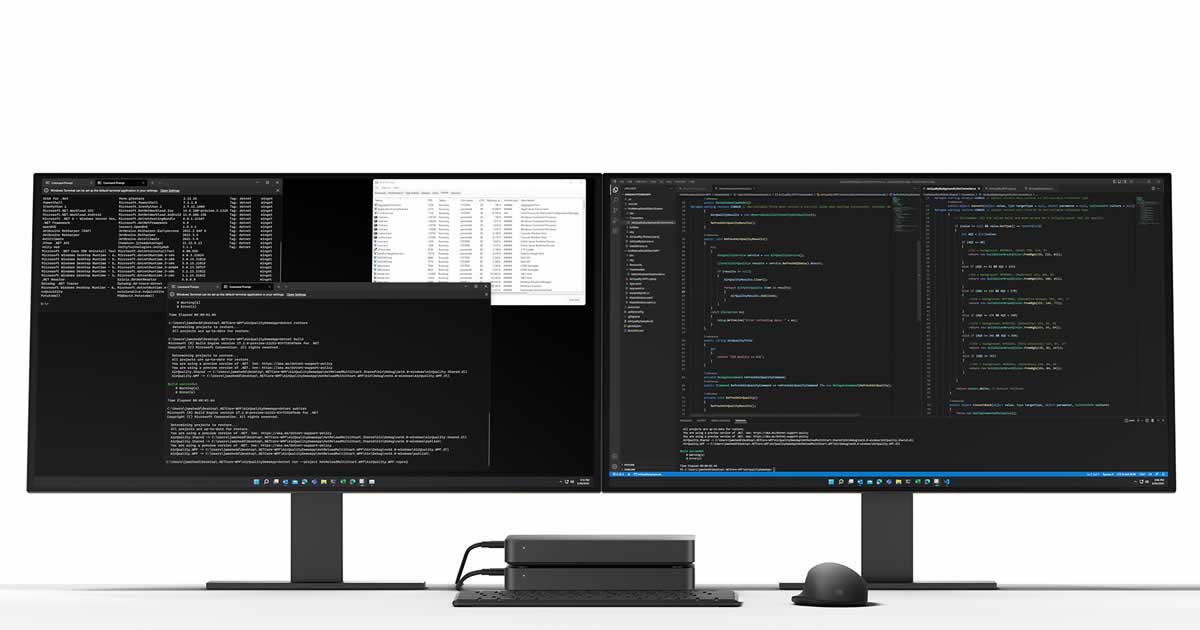
At its annual developer conference Build 2022, Microsoft unveiled its first Windows Development Kit on ARM — Project Volterra — a minicomputer similar to Apple’s Mac Mini that hides a Qualcomm ARM processor inside.

The hardware is a development platform designed specially to help developers to build applications that take advantage of new AI capabilities with the built-in Neural Processing Unit (NPU) and add support for Windows 11 on ARM.

As far as ports are concerned, Project Volterra has three USB-A ports, one DisplayPort, one Ethernet, and two USB-C ports. The device’s chassis, moreover, has been made with recycled plastics from the ocean.

Microsoft has said it’s an Arm-based device running Qualcomm’s Snapdragon computing platform — whether it’s the Snapdragon 8cx Gen 3 or something else, we don’t know yet.

Microsoft Project Volterra with Qualcomm ARM

In addition, Qualcomm announced a new Qualcomm Neural Processing SDK for Windows toolkit to help developers explore AI scenarios in their applications. Microsoft intends to bring NPU support to the end-to-end Windows platform.

Microsoft is also releasing a number of software tools for ARM, such as Visual Studio 2022 and VSCode, Visual C++, Modern .NET 6 and Java, Classic .NET framework, Windows Terminal, and WSL and WSA to run Linux and Android applications. The first preview of these tools will be available in the next few weeks.

Dimensity 1050: First MediaTek SoC With Support For 5G mmWave

First MediaTek SoC With Support For 5G mmWave

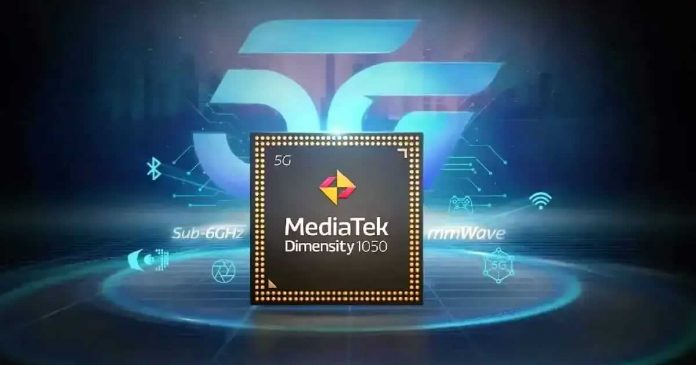
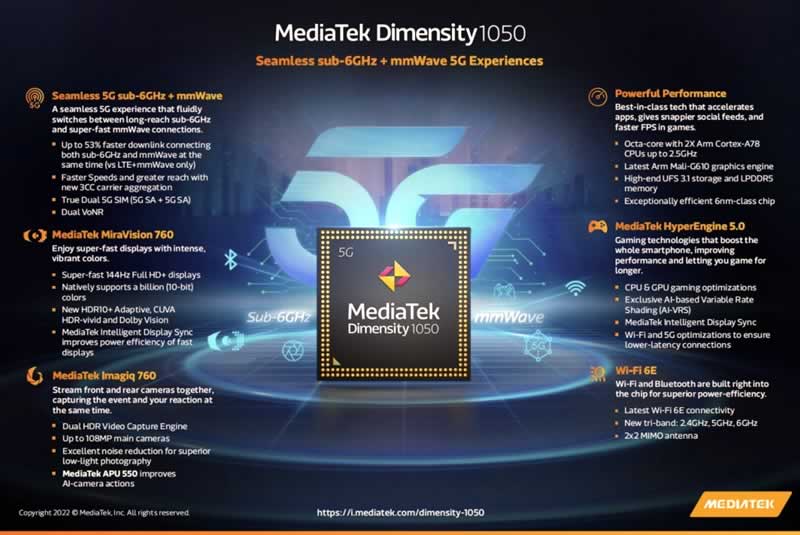
The Taiwanese company MediaTek has announced the arrival of the new Dimensity 1050 mobile processor, its first processor with support for dual 5G mmWave and sub-6GHz connectivity.

The new chipset is built under a 6 nm process and is slightly scaled-down version of the Dimensity 1100. The integrated CPU uses octa-core architecture, two of which are ARM Cortex-A78 clocks at 2.5 GHz. The company hasn’t dwelled on the characteristics of the remaining cores, but it is likely that they are six Cortex-A55s.

The chip also received an ARM Mali-G610 GPU core with support for MediaTek HyperEngine 5.0. The latter offers additional tools and optimization features to improve performance in games. The SoC supports UFS 3.1 flash storage, LPDDR5 RAM, Full HD + displays with up to 144Hz refresh rate, AV1 video decoding in hardware, HDR10 + playback and Dolby Vision.

MediaTek Dimensity 1050

MediaTek hasn’t specified the modem used in the SoC, but the company released its first 5G modem with mmWave, the M80, in early 2021. In addition to 5G capabilities, the company is also touting improvements in Wi-Fi speeds with tri-band support for 2.4GHz, 5GHz, and 6GHz connections and Wi-Fi 6E. 

The first devices powered by MediaTek Dimensity 1050 will be available on the market between July and September 2022.

MediaTek Dimensity 930 5G

MediaTek Dimensity 930 5G

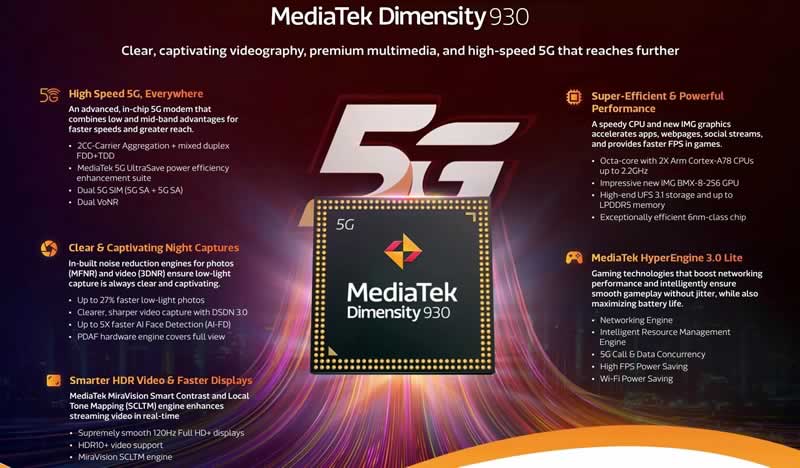
MediaTek Dimensity 930 is the successor of Dimensity 920. The MediaTek Dimensity 930 promises cheaper 5G smartphones with 120 Hz fast 1080p+ displays, HDR10+ video recording and a long battery life. Dimensity 930, however, supports UFS 3.1 storage and LPDDR5 RAM memories, features until now reserved only for the top tiers. The first smartphones with Dimensity 930 are expected in the second quarter of 2022.

MediaTek Helio G99 LTE

MediaTek Helio G99 LTE

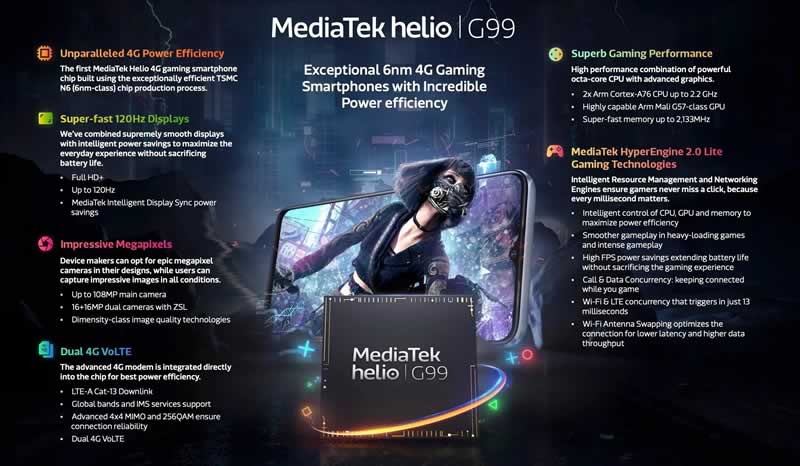
MediaTek Helio G99 is designed to offer a good quality gaming experience in the mid-range, guaranteeing up to 30% more energy efficiency than its predecessor. The new SoC uses a different CPU architecture, offering two 2.2GHz Cortex-A76 cores and six 2.0GHz Cortex-A55 cores. On the connectivity side, the SoC stops at LTE networks, with support for dual SIM and VoLTE and ViLTE services, and support for WiFi 5, Bluetooth 5.2 and FHD + 120Hz display is guaranteed. On the graphics side we find an ARM Mali-G57 MC2 GPU, while the memory compartment can be based on LPDDR4X RAM and UFS 2.2 storage. The first smartphones with Helio G99 will hit the market by the end of the third quarter of this year.

AMD Unveiled More Details Of Its Ryzen 7000 And Mendocino CPUs

AMD Ryzen 7000 And Mendocino

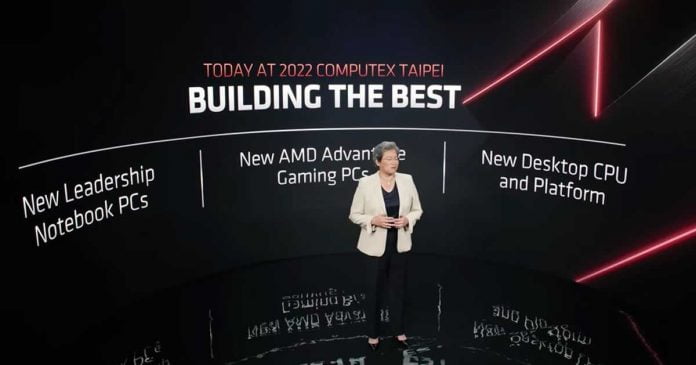
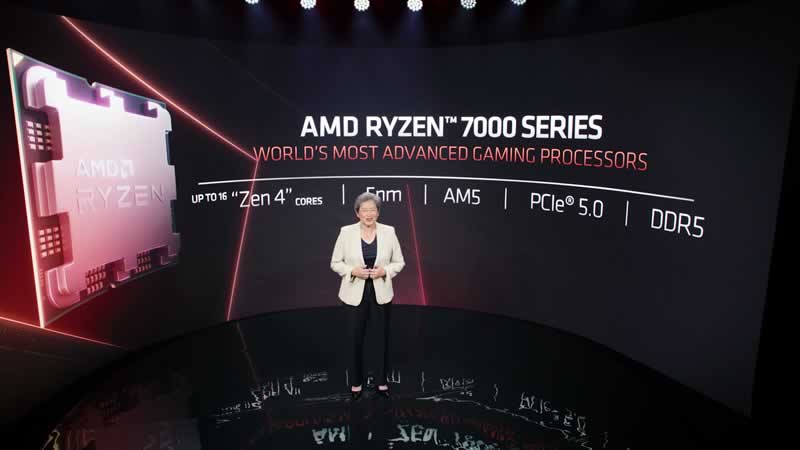
In Computex 2022, AMD shows the first performance demonstration of the Ryzen 7000 alias Raphael. The company led by Lisa Su said that the new CPUs and AM5 socket platforms will arrive in the fall, introducing not only the Zen 4 architecture but also full support for technologies such as DDR5 and PCI Express 5.0.

AMD Ryzen 7000 series first demo

The new Zen 4 architecture will offer double the L2 cache per core, from 512KB to 1MB, as well as an expanded instruction set for handling artificial intelligence tasks. Thanks to the new design and the frequencies that in “Max Boost” will exceed 5 GHz, AMD expects an improvement of more than 15 percent in single-thread performance.

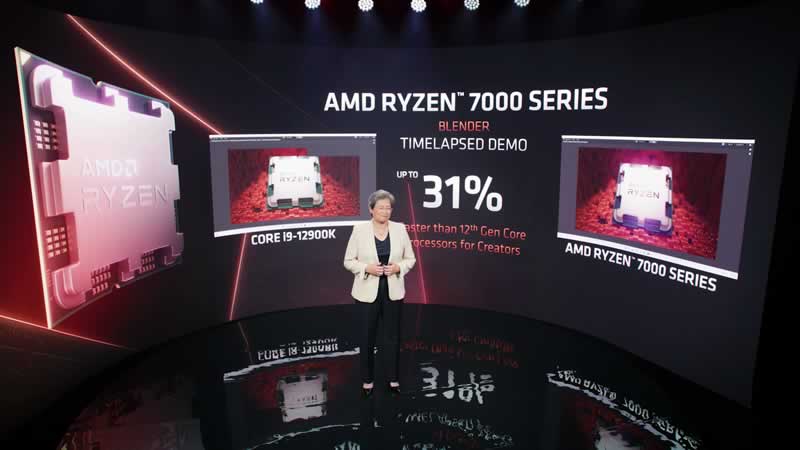
AMD, in its presentation, put a Ryzen 7000 processor in front of Intel’s most powerful processor, the Core i9-12900K. This one had 16 cores and 32 threads, showing the Ryzen to be faster than Intel’s i9, again with a native TDP of 170W.

The chip was put to the test with Blender, where it proved 31 percent faster than a Core i9-12900K, finishing the workload in 204 seconds versus Intel’s 297 seconds. The chip was also tested in gaming with Ghostwire: Tokyo, where it managed to reach 5.52 GHz on the single-core, a frequency similar to the Core i9-12900KS.

Ryzen 7000 vs intel Core i9-12900K

According to AMD boss Lisa Su, the Ryzen 7000 aka Raphael will appear in autumn 2022.

AM5 and Motherboards

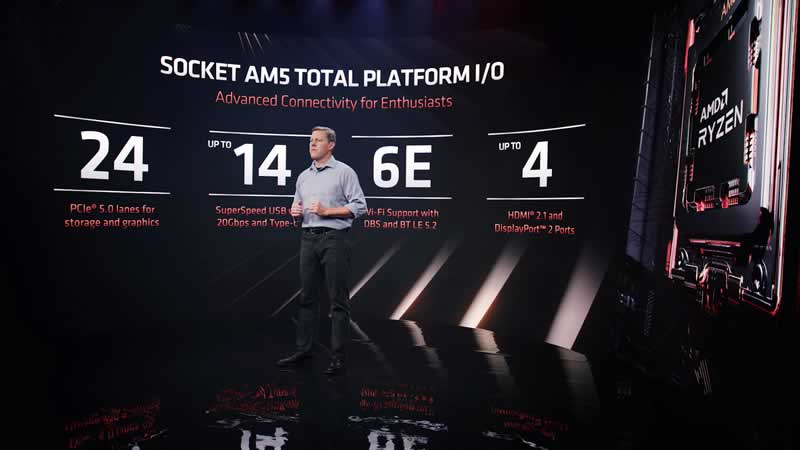
The new AMD Socket M5 platform features a 1718-pin LGA design with support for TDP processors up to 170W and dual-channel DDR5 memory. Also, for the new power infrastructure SVI3. Compatible with Ryzen 7000 processors, it has up to 234 PCIe 5.0 slots.

AM5 Socket

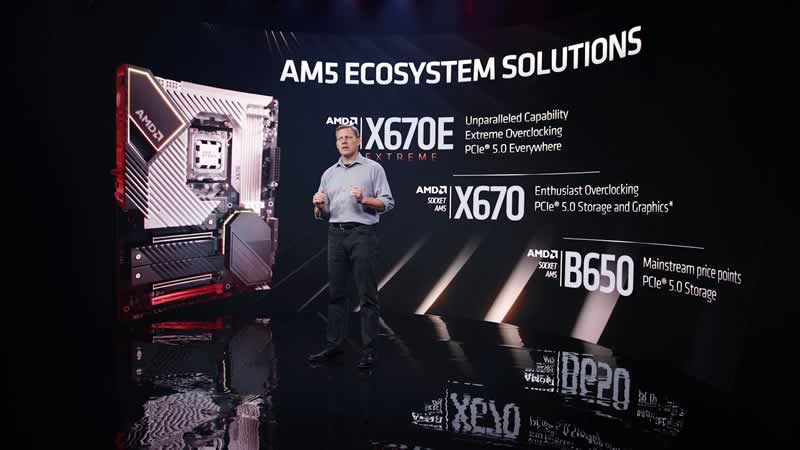
These new processors come with new motherboard chipsets. Two versions of the X670 chipset, designed for top-of-the-line boards and B650, for mid-range and low-end.

AM5 Socket solution

X670 Extreme, which features PCIe 5.0 support for two graphics slots and one storage slot. The second version X670 comes with PCIe 5.0 support for a storage slot with optional graphics support. And the third one B650, is designed for performance-conscious users, with support for PCIe 5.0 storage. Among the manufacturers that will launch motherboard models that will have AM5 at any of its levels are, for the moment, Asrock, Asus, Biostar, Gigabyte and MSI.

AMD Mendocino

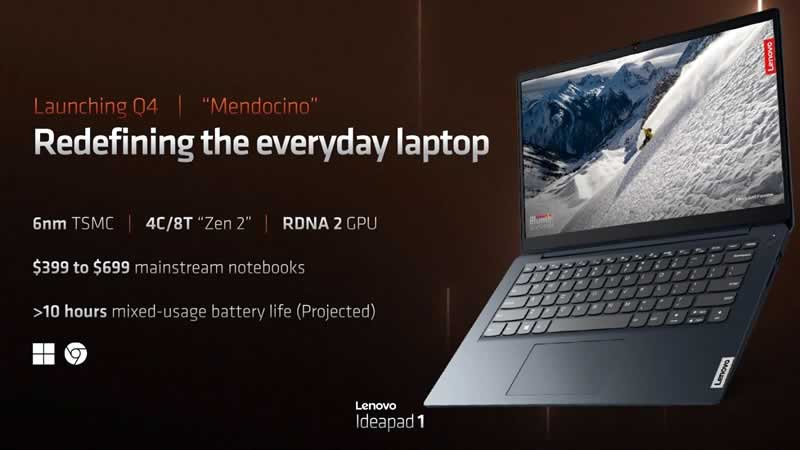
In addition to the new Ryzen 7000, AMD has revealed more information about the “Mendocino” family — an APU with a Zen 2 core and integrated RDNA 2 graphics for notebooks in the range between $399 and $699.

AMD Mendocino

These will be developed in a 6 nm process and offer laptops with more than ten hours of battery life. Mendocino processors will arrive in the fourth quarter of 2022.

Qualcomm Showcases New Reference Design Wireless AR Smart Viewer Powered by Snapdragon XR2

Qualcomm Wireless AR Smart Viewer Snapdragon XR2

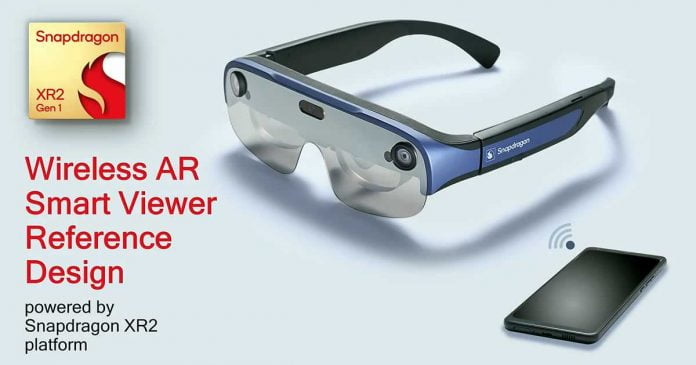
Qualcomm has announced another milestone in making augmented reality the next computing platform with the Wireless AR Smart Viewer reference design powered by the Snapdragon XR2 platform.

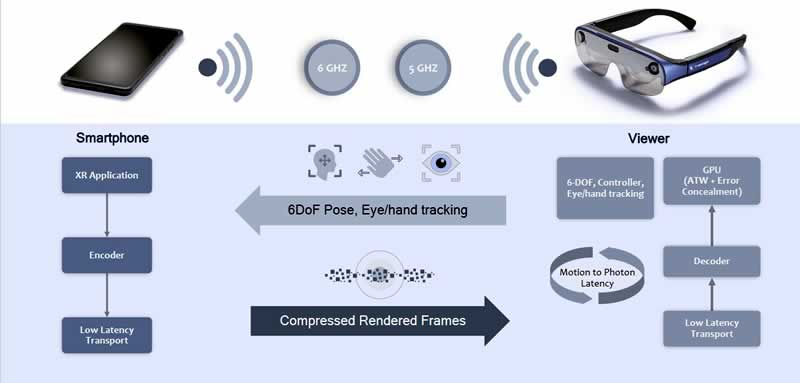
The new Qualcomm AR glasses make co-processing possible on a wirelessly connected smartphone. The computing power of the smartphone or PC is used via WiFi 6 for the demanding rendering tasks, while the chip in the glasses takes care of the 6DoF tracking locally.

The reference design presented by Qualcomm is aimed at OEMs and ODMs, who can use this as a basis to develop their own AR solutions at low cost to deliver an immersive experience that opens up the metaverse. The solution developed by Qualcomm together with Goertek relies on two micro-OLED displays, each with full HD resolution for each eye and a refresh rate of 90 Hertz. A launch that is ahead of Apple, which has been working on its own mixed reality glasses for years.

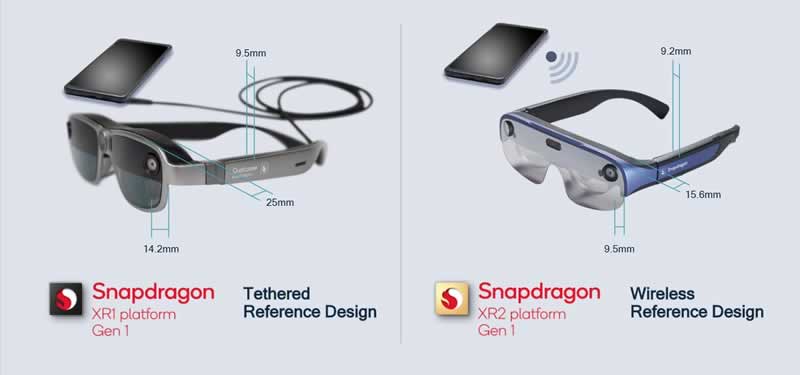
Compared to the previous generation, the new AR glasses are updated not only on the outside but also on the inside, debuting the Snapdragon XR2 Gen 1, which boasts greater processing power for computer vision and other tasks.

Qualcomm Snapdragon XR2 Wireless AR Smart Viewer

In addition, Qualcomm boasts of having achieved an ultra-fast latency of only 3 milliseconds between the glasses and the device to which they have connected, thanks to FastConnect 6900 technology for WiFi 6E and Bluetooth connections. Qualcomm predicts that the glasses’ 650mAh battery will only last about 30 minutes with continuous use, so its actual usefulness is pretty limited.

Qualcomm Snapdragon XR2 Wireless AR Smart Viewer reference

The Snapdragon XR2 in the AR glasses uses image data from two monochrome cameras and a classic RGB camera to track head movements. According to Qualcomm, this should ensure reliable 6DoF tracking as well as hand and gesture control. To date, most competing products have not been able to do this 100 percent reliably, even with more cameras, especially in poor lighting conditions.

Since Qualcomm is not targeting the end customer market with the reference design, there is neither an exact price nor a statement as to when products based on this technological basis can be expected.

EA Is Looking For A Potential Buyer Or A Merger Partner

Electronic Arts news

Electronic Arts would be looking for a sale or merger agreement with another big company. In recent years, EA has held talks with numerous candidates from the media industry. Among them were Disney, Apple and Amazon, reports Dylan Byers on the news site Puck.

EA’s goal would be to keep Andrew Wilson as the CEO of the new combined company. Presumably, therefore, it would be an agreement like the one between Microsoft and Activision Blizzard.

According to Gamesindustry, Andrew Wilson had just held the last relevant talks with Brian Roberts, head of the media group NBC Universal. The talks between the company leaders are said to have dragged on for several weeks. Ultimately, they failed due to details about the price and the future structure.

At the same time, EA recently announced the end of the collaboration with FIFA for its famous soccer game, the group’s best-selling title and FIFA would be called EA Sports FC in the future.

There have also been reports in recent weeks that Ubisoft’s owners are actively looking for a buyer. However, company boss Yves Guillemot — whose family holds around 18.5 percent of the shares — recently said that one would actually like to remain independent.

In recent years, companies like Sony, Tencent and The Embracer Group have bought many development studios and game publishers. Both Electronic Arts and Ubisoft have so far held back on these acquisitions.

Apple Shows Prototype Mixed Reality Headset To Board of Directors

Apple Mixed Reality Headset news

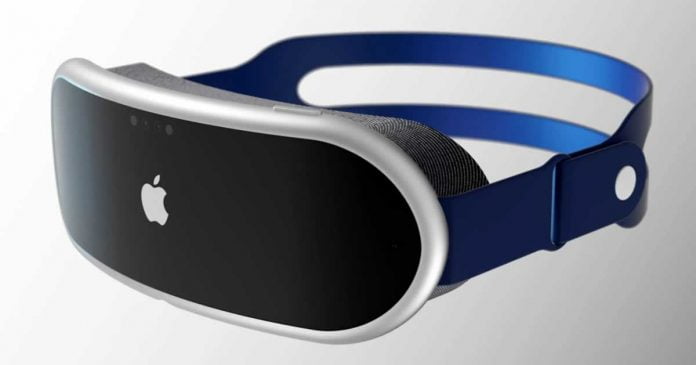
Apple would have made important advances in the development of its mixed reality glasses. According to Bloomberg, the device has already been shown to the board members of the Cupertino company.

The company’s board of eight members and Apple CEO Tim Cook meets at least four times a year. The prototype of the device was demonstrated to the directors of the company during the last meeting. The project behind Apple’s mixed reality glasses has been in force for about 6 or 7 years, according to different reports. 

As the device got ready, Apple stepped up efforts to create Reality OS, or rOS, an operating system for virtual and augmented reality devices. Progress in rOS development, coupled with the presentation, suggests that the product is nearing completion, and we may see Apple’s headset in the coming months, with it scheduled to go on sale in 2023 — writes The Verge.

Apple’s AR/VR headset is expected to feature two 4K micro-OLED displays, 14 cameras, powerful processors equivalent to the Apple M series chips, eye and hand tracking, spatial audio, and more. Early leaks noted that the device would be much lighter and more comfortable than other AR/VR headsets on the market.

As usual, Apple does not release details until the official announcement.

Qualcomm Launches Snapdragon 8+ Gen 1 And Snapdragon 7 Gen 1 For The High-End And Mid-Range Smartphones

Snapdragon 8 Plus Gen 1 And Snapdragon 7 Gen 1

Qualcomm has launched new processors for the high-end and mid-range Android smartphones — Snapdragon 8+ Gen 1 And Snapdragon 7 Gen 1.

Snapdragon 8+ Gen 1

With the Snapdragon 8+ Gen 1, Qualcomm is beefing up the Snapdragon 8 Gen 1 flagship SoC. There are no differences in the range of functions, but the clock rates increase, and consumption decreases. The “4 nm process” remains, but it now comes from TSMC and is no longer from Samsung. 30 percent efficiency has been gained for the GPU and the CPU of this new flagship chip.

Snapdragon 8+ Gen 1 with a 64-bit architecture reaches 3.2 GHz speed. It is accompanied by the Adreno 730 GPU with Vulkan 1.1 support, HDR10 +, HDR10 and Dolby Vision support and an artificial intelligence processor, the Hexagon Processor.

Snapdragon 8 Plus Gen 1

According to Qualcomm, the new SoC achieves the same CPU and GPU performance as its predecessor while consuming 30 percent less power. With the new higher clock rates, the advantage is a bit smaller in absolute terms, but it is still considerable. Overall, Qualcomm speaks of a 15 percent reduction in power consumption of the SoC.

Devices powered by Snapdragon 8+ Gen 1 are expected to be available from Q3 2022 from many manufacturers, including Asus ROG, Xiaomi BlackShark, Honor, iQOO, Lenovo, Motorola, Nubia, OnePlus, Oppo, Realme, RedMagic, Redmi, Xiaomi, Vivo and ZTE, among others.

Snapdragon 7 Gen 1

Snapdragon 7 Gen 1 is the first iteration of the company’s Snapdragon 7-Series focusing on mid-range smartphones. This SoC is also manufactured in 4 nm — but still by Samsung.

Snapdragon 7 Gen 1 is equipped with a Kryo CPU cluster clocked at up to 2.40 GHz and is paired with the Adreno 662 GPU. Qualcomm does not provide details on the speed of this CPU cluster but states that the GPU is 20 percent faster than the block running in the Qualcomm Snapdragon 778G. The chipset manufacturer also claims that the Snapdragon 7 Gen 1 will be up to 30 percent faster in AI-related tasks compared to the predecessor.

Snapdragon 7 Gen 1

The Snapdragon 7 Gen 1 does not have a flagship 5G modem, but the Snapdragon X62 is more than capable because it is capable of a maximum download speed of 4.4 Gbps while supporting a dual 5G standby connection. The new SoC also supports Wi-Fi 6E and Bluetooth 5.3 with support for Snapdragon Sound and aptX, but these will need to be implemented by the phone manufacturer.

Qualcomm has confirmed that the SoC will power smartphones from Oppo, Honor and Xiaomi in the second half of 2022.